
Listen to This Blog Post
Private credit closed 2025 with resilient performance, tighter spreads, and evolving fundraising dynamics, even as institutional investors navigated concerns around technology exposure and liquidity pressures in parts of the market. The asset class continued to benefit from its defensive characteristics and strong lender protections, helping it outperform credit benchmarks over longer time horizons.
Key Trends in Private Credit
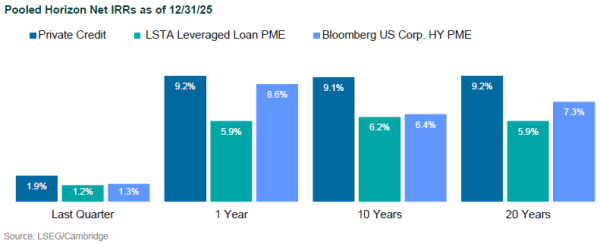
Returns | Performance across private credit strategies remained solid in 4Q25. Total private credit generated a 1.9% pooled horizon net internal rate of return (IRR) for the quarter and 9.1% over the last 10 years ended Dec. 31, 2025. Higher-risk strategies, including subordinated debt and credit opportunities, continued to outpace senior debt over longer periods. Over the past decade, private credit outperformed leveraged loans and high yield bonds.
Fundraising | Trends reflected a notable shift in investor appetite. Capital formation increasingly favored asset-based finance (ABF) and specialty finance strategies rather than traditional U.S. direct lending. Two of the four largest private credit funds closed during the quarter focused on ABF. Managers and investors alike continue to expand beyond core direct lending strategies in search of differentiated return streams and complementary sources of income.
At the same time, overall fundraising activity continued to slow. The number of funds closed in 4Q25 fell meaningfully from prior quarters, while aggregate capital raised also moderated. The environment increasingly resembles other areas of the private markets in which larger, established managers capture a disproportionate share of available capital.
Spreads | Credit market conditions improved steadily throughout the year. Average spreads and yields on M&A-related loans compressed materially as investor demand for leveraged credit strengthened and concerns about defaults eased. Average spreads narrowed from 388 basis points at the end of 2024 to roughly 325 basis points by year end 2025, while yields to maturity declined from 9.0% to 7.5%. Lower base rates, improving issuer fundamentals, and persistent demand from lenders and investors all contributed to tighter financing conditions.
Issuance | M&A-related loan issuance also rebounded modestly. Total institutional M&A loan issuance reached approximately $142 billion in 2025, including leveraged buyouts, sponsor-backed add-ons, and corporate acquisitions. Activity improved as financing markets reopened and confidence among strategic buyers strengthened. Still, volumes remained well below the peaks reached during 2021 as valuation mismatches, slower transaction execution, and lingering macro uncertainty continued to weigh on deal flow.
Headlines | One of the more notable developments during the quarter involved the market’s growing focus on technology-related credit exposure. Private credit managers have increasingly financed software companies. Software lending, long viewed as attractive because of recurring revenue and potential equity upside, has recently drawn greater scrutiny as rapid advances in artificial intelligence create uncertainty around long-term business models and valuations. These concerns contributed to volatility in public business development companies (BDCs) and rising redemption requests at some semi-liquid private credit funds.
Despite isolated credit events and pockets of stress, the widely anticipated post-tightening default cycle has remained relatively muted. Private credit default rates have continued to track below those of the high yield market, aided by covenant protections, sponsor support, and lenders’ ability to intervene earlier in stressed situations. Manager selection, underwriting discipline, and workout expertise remain key differentiators as the market works through a more complex and evolving environment.
Disclosures
The Callan Institute (the “Institute”) is, and will be, the sole owner and copyright holder of all material prepared or developed by the Institute. No party has the right to reproduce, revise, resell, disseminate externally, disseminate to any affiliate firms, or post on internal websites any part of any material prepared or developed by the Institute, without the Institute’s permission. Institute clients only have the right to utilize such material internally in their business.