
Listen to This Blog Post
Real assets delivered a nuanced set of results in 1Q26, with signs of stabilization emerging in private real estate even as public markets reflected a more uneven recovery. Income remained the primary driver of returns across private markets, while listed real assets benefited from a sharp rally in energy-related sectors. Together, these dynamics point to a market that is transitioning—albeit unevenly—toward a more balanced footing.
Private Real Estate: Income Leads, Appreciation Lags
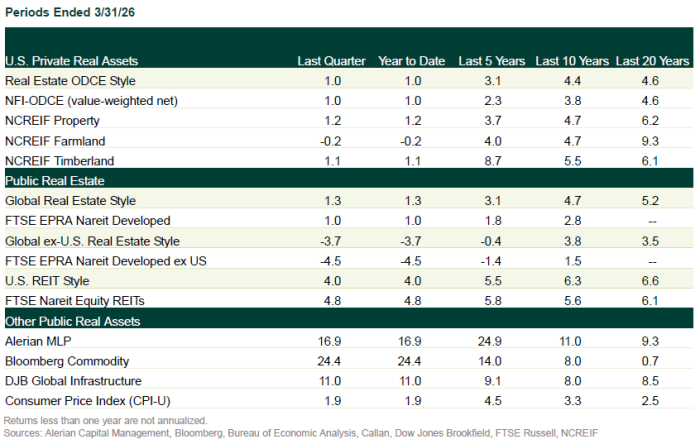
Private real estate performance showed modest improvement during the quarter. The NCREIF Open-End Diversified Core Equity (ODCE) Index gained 1.0%, driven largely by income returns of 0.8%, while appreciation contributed 0.2%. This pattern remains consistent with recent periods, as property-level cash flows continue to provide stability amid still-muted valuation changes.
Sector-level results highlight the uneven nature of the recovery. Industrial properties were the lone major sector to post positive appreciation, while the Residential, Hotel, Office, and Retail sectors experienced declines. Hotel properties, in particular, stood out for negative appreciation, underscoring ongoing volatility in more economically sensitive segments. Regional performance also diverged, with the West lagging due to softening industrial fundamentals in Southern California.
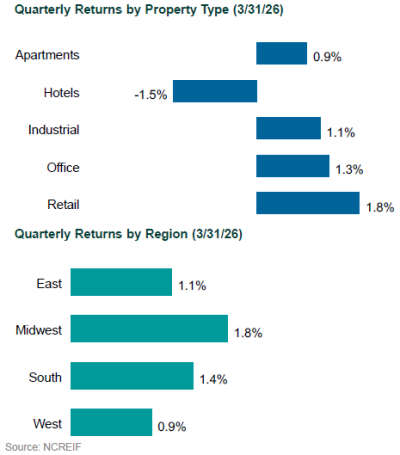
Encouragingly, fundamentals appear to be stabilizing. Appreciation trends have flattened across most sectors, suggesting that the bulk of valuation resets may be behind the market. However, dispersion among managers within the ODCE Index remains elevated, driven by differences in sector allocations and portfolio positioning.
Portfolio Evolution and Market Structure
Structural shifts within core real estate portfolios continue to reshape the opportunity set. Over time, allocations have moved away from Office and Retail and toward Industrial, Multi-Family, and Alternative assets. These changes reflect a preference for sectors with lower capital expenditure requirements and less direct sensitivity to economic growth.
Geographic exposure remains concentrated in coastal markets, though evolving supply chain dynamics and regional economic trends may gradually influence allocation decisions.
Liquidity conditions are also improving. Redemption queues for ODCE funds continue to decline, falling to approximately 10.2% of net asset value (NAV) after peaking in early 2024. This improvement reflects a combination of increased transaction activity and rescinded redemption requests, signaling a gradual normalization in fund flows.
At the same time, capital remains abundant. Dry powder for commercial real estate investment exceeds $230 billion, providing a substantial base for future deployment as transaction opportunities emerge.
Transactions and Capital Markets: Activity Rebounds
Transaction activity continues to recover from its recent trough. On a rolling four-quarter basis, both transaction volume and value have increased and now exceed five-year averages. While activity remains below 2022 levels, the rebound suggests that pricing has largely adjusted to higher borrowing costs, allowing buyers and sellers to re-engage.
Capital markets conditions are also evolving. Bank lending activity has begun to recover, but lower loan-to-value ratios are forcing borrowers to seek additional capital, creating opportunities for various lender types (insurance companies, debt funds, agencies). Ample debt is available as spreads have tightened, creating a tailwind for transactions.
Liquid Real Assets: Energy Drives Performance
In liquid markets, commodities delivered strong gains, led overwhelmingly by energy. The S&P GSCI Energy Total Return Sub-Index surged amid geopolitical tensions and supply concerns, while other commodity sectors—including metals and agriculture—also posted solid gains.
Listed real assets reflected a similar pattern. Natural resources equities benefited from higher energy prices, and listed infrastructure generated positive returns as investors rotated toward more defensive sectors.
REIT performance was positive overall but varied significantly by sector. U.S. REITs rose 4.9% for the quarter, outperforming the broader equity market, while global REITs gained 1.0%. However, performance dispersion remained pronounced, with self-storage advancing sharply while the Office and Residential sectors declined.
Public market valuations continue to present opportunities. Global REITs are trading at a discount of approximately 10.5% to net asset value, wider than historical norms. This dynamic, combined with ample private capital, may support increased M&A or take-private activity.
Infrastructure: Fundraising Rebounds Amid Mixed Conditions
Infrastructure markets present a similarly mixed picture. Fundraising rebounded in the first half of 2025, driven largely by mega funds, which accounted for a significant share of capital raised. At the same time, the opportunity set continues to broaden, with growth in strategies focused on energy transition, digital infrastructure, and emerging markets.
The macro backdrop remains complex. Headwinds include elevated interest rates, regulatory uncertainty, and potential economic slowdown. However, long-term tailwinds—such as digitization, energy transition, supply chain reconfiguration, and aging infrastructure—continue to support investment demand.
Conclusion
1Q26 suggests that real assets are moving toward a more stable footing, though the path forward remains uneven. Private real estate shows early signs of stabilization, supported by income and improving liquidity conditions. Meanwhile, public markets and commodities highlight the continued influence of macroeconomic and geopolitical forces.
For institutional investors, the environment reinforces the importance of selectivity, sector positioning, and a long-term perspective. As capital markets normalize and transaction activity recovers, opportunities are likely to emerge—but they will require careful navigation across an increasingly differentiated landscape.
Disclosures
The Callan Institute (the “Institute”) is, and will be, the sole owner and copyright holder of all material prepared or developed by the Institute. No party has the right to reproduce, revise, resell, disseminate externally, disseminate to any affiliate firms, or post on internal websites any part of any material prepared or developed by the Institute, without the Institute’s permission. Institute clients only have the right to utilize such material internally in their business.