
Listen to This Blog Post
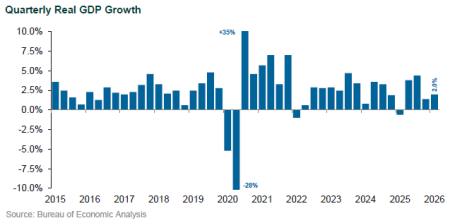
Real GDP rose 2% in 1Q26, the first broad economic measure that included the impact of the Iran war and the spike in oil prices on the U.S. economy. A gain of 2% suggests a resilience to the economy that has persisted after a seemingly endless string of triggers to capital markets and economic uncertainty. 2025 saw the inauguration of President Trump; the chaotic introduction of a very wide and constantly changing schedule of tariffs in 1Q25; the deployment of Immigration and Customs Enforcement (ICE) forces into American cities, interrupting the daily economic activity of the surrounding city (or area); a surge in deportations of undocumented immigrants, many of whom made up a sizable portion of the labor force in agriculture, services, and construction; a sudden halt to legal immigration; and the cessation of job creation in the U.S. labor market. Let’s not forget a government shutdown that began in October 2025 and lingers to this day, with some government employees’ pay still being withheld into 2Q26. The U.S. began 2025 with a small decline in GDP (-0.6%) in 1Q, but then growth surged through the second and third quarters and finished the year with a solid gain of 2.0% for the entire year.
Then the U.S. and Israel began a war with the bombing of Iran on Feb. 28, 2026. Aside from the death and destruction in the Middle East, the immediate global impact of the action was on the price of oil, which shot from $60 per barrel at the start of the year to over $100, and the closing of the Strait of Hormuz, through which 20% of the world’s supply of crude passes. Customers in Asia have been particularly affected by the restriction in oil supply. While the supply impact may be regional, the price of oil is set globally. The U.S. may tout energy self-sufficiency, but the price of West Texas Intermediate (WTI) crude is not set by U.S. supply/demand conditions, but in the global energy market. In addition to energy markets, the focus of many analysts has been on business and consumer confidence, which has plummeted since the start of March, a typical response to the outbreak of war. However, the U.S. economy continued its streak of resilience into 1Q26 with this latest GDP report.
Looking forward, a macro rule of thumb is that for each $10 rise in the price of a barrel of oil, U.S. GDP growth is reduced by 20 basis points. The $40 rise through the end of March suggests an 80 bps hit (almost 1 percentage point) to GDP growth. If prices go higher, or remain elevated into 2027, the impact will build, and the risk of an energy-triggered recession rises.
A disconnect that Callan pointed out in 2025 continued into 2026, namely, that economic indicators which once provided solid direction on the course for the U.S. and global economies and the capital markets appear to have lost either their relevance or their predictive power. The data appears to be sound, but their signals are no longer clear, or it is increasingly difficult to separate signal from noise. Inverted yield curves used to presage recessions, but we have been in some form of inversion since 2023 without a recession. Consumer confidence and job creation have plummeted, yet spending remains robust and as a result consumption and GDP show resilience.
Callan has developed a new chart we will begin to distribute monthly that we call “EconIndicators,” starting in 2Q26. A review of the chart that includes data through 1Q26 highlights the anomaly between traditional measures of economic health, sentiment, and market prices and the seemingly robust economic activity reported through broad measures like GDP, consumption, housing, imports, and exports. For example, consumer sentiment is at an all-time low, yet consumer spending continues apace. The spread between yields on risky bonds like investment grade credit and high yield are extremely tight. That suggests spreads have nowhere to go but wider, usually a sign of a weakening economy—yet these spreads continue to grind tighter. The forward price/earnings ratio for the S&P 500, which is an indicator of how cheap or expensive the stock market is relative to its own history, has retreated from a near-record high set just before the Iran conflict, but the ratio is still well above its long-term average. Investors appear loathe to miss out on a continued market run. Stocks globally have rallied to regain their losses incurred when the Iran war began, and non-U.S. stocks have rallied the most. Fear of missing out is a powerful factor.
Disclosures
The Callan Institute (the “Institute”) is, and will be, the sole owner and copyright holder of all material prepared or developed by the Institute. No party has the right to reproduce, revise, resell, disseminate externally, disseminate to any affiliate firms, or post on internal websites any part of any material prepared or developed by the Institute, without the Institute’s permission. Institute clients only have the right to utilize such material internally in their business.