
Private credit fundraising rebounded sharply in 2Q26, even as quarterly returns lagged public credit markets. Large fund closes drove the increase in capital raised, while direct lending continued to compete with syndicated loans for financing large buyouts.
Credit deterioration remained uneven. Smaller borrowers showed greater stress, and technology exposure raised questions about software companies’ prospects and the pace of artificial intelligence infrastructure investment. Data extending into 3Q26 also showed continued pressure on lending spreads.
Key Trends in Private Credit
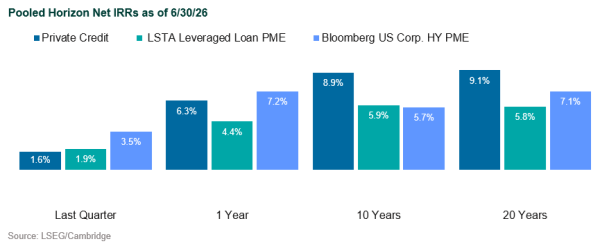
Returns | Private credit generated a pooled horizon net internal rate of return (IRR) of 1.6% in 2Q26, according to LSEG/Cambridge. That trailed public market equivalent returns of 1.9% for leveraged loans and 3.5% for high yield bonds. Credit opportunities led private credit strategies at 2.4%, followed by subordinated debt at 1.0% and senior debt at 0.5%.
Longer-term results remained stronger than both public credit comparisons. Private credit’s net IRR reached 8.1% over five years, 8.9% over 10 years, and 9.1% over 20 years. Higher-risk strategies continued to lead over the past decade: Subordinated debt generated a 10.7% net IRR, compared to 7.4% for senior debt.
Fundraising | Capital raised approached $100 billion in 2Q26, one of the strongest quarters in recent years, according to Preqin. Relatively few funds closed, underscoring the concentration of commitments among larger managers. The four largest closes totaled approximately $38 billion, nearly 40% of quarterly fundraising.
Those closes spanned multiple strategies. Crescent Direct Lending Fund IV raised $10.8 billion, Blackstone Capital Opportunities Fund V attracted $10 billion for mezzanine investing, and Ares Pathfinder Fund III raised $8.5 billion for asset-based finance. Antares Senior Loan III also raised $8.5 billion.
Spreads | Pitchbook data for 3Q26 showed that 86% of year-to-date direct lending deals priced below 550 basis points (bps), compared to 3% in 2022. More than half priced between 450–499 bps. Higher-spread deals nearly disappeared: None priced between 600–699 bps, and just 1% priced at 700 bps or higher.
Buyout Financing | Direct lending financed approximately one-third of global buyouts exceeding $1 billion in 2026 through September 30, up from less than 10% in 2015, according to Pitchbook. But direct lending’s share moderated from the 2023 peak as syndicated loan markets regained competitiveness.
Credit Quality | Houlihan Lokey reported a 0.8% principal-weighted private credit default rate in 2Q26, versus 2.5% by borrower count. For companies with less than $100 million in EBITDA, those figures rose to 3.0% and 3.6%, respectively. Amendments and maturity extensions, sponsor support, and lender intervention helped mitigate defaults, although they may defer some deterioration.
Technology Exposure | Software represents an estimated 20% of private credit lending. AI disruption challenges assumptions about recurring revenues and predictable cash flows, while rapid data center development raises concerns about overinvestment. Software refinancing needs are expected to accelerate in 2028 and remain elevated through 2032, potentially creating distressed opportunities for specialized managers.
Retail Vehicles | Public business development companies have faced share price pressure over credit quality and valuations. Semi-liquid funds generally cap quarterly repurchases at approximately 5% of net asset value, creating potential liquidity mismatches with underlying investments. Elevated requests prompted some managers to exceed limits, while others maintained caps to protect remaining investors. Among the 15 largest business development companies, software and services represented approximately 21% of payment-in-kind loans by count, highlighting exposure to an industry facing disruption and refinancing challenges.
Disclosures
The Callan Institute (the “Institute”) is, and will be, the sole owner and copyright holder of all material prepared or developed by the Institute. No party has the right to reproduce, revise, resell, disseminate externally, disseminate to any affiliate firms, or post on internal websites any part of any material prepared or developed by the Institute, without the Institute’s permission. Institute clients only have the right to utilize such material internally in their business.