
In 2023, we wrote about why stable value funds were trailing money market funds in the wake of the Federal Reserve’s rapid rate hikes. Three years later, stable value continues to lag despite rate cuts by the Fed in 2024 and 2025, and many defined contribution plan sponsors and participants are understandably losing patience. So why is stable value still underperforming? Where does the market stand, and what should investors expect?
Stable Value Funds 2026: Where We Stand
When we last wrote about this topic, the Federal Reserve was nearing the end of its most aggressive rate-hiking campaign of the modern era, ultimately increasing its target rate by 525 bps in less than 17 months as it attempted to combat inflation levels not seen in decades. Treasury yields rose sharply across the curve as markets priced in higher inflation expectations.
The impact on the bond market was severe; the Bloomberg US Aggregate Bond Index declined 7.6% on an annualized basis from Jan. 1, 2022, to June 30, 2023. Yet stable value funds held up, as the median return for the Callan Stable Value Collective Trust Peer Group was a positive 1.7%.
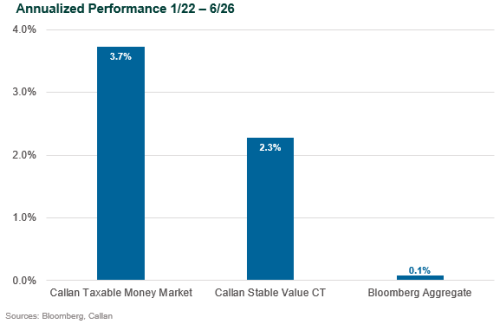
Despite that advantage over the Agg, however, stable value has underperformed money market funds over the full period from Jan. 1, 2022, to June 30, 2026, as the median stable value fund returned 2.3% compared to 3.7% for the Callan Taxable Money Market Peer Group median.
It is important to remember that stable value is designed to preserve capital, provide liquidity, and deliver a stable level of income with low volatility. And despite trailing money market funds, it has done exactly that. Since the beginning of 2022, the median stable value fund has maintained a positive return in every quarter with an average annualized crediting rate of around 2.7%. Return volatility has been just 0.15%, roughly a third of the money market fund universe median.
However, the same structural features that helped protect stable value investors during the bond market selloff have also slowed its recovery. Stable value funds use wrap contracts that allow participants to transact at book value while the underlying portfolio invests across a broader spectrum of high-quality fixed income securities with longer maturities than a money market fund can hold.
But duration has a downside, as bond prices move inversely with rates, and that longer duration was a major headwind in 2022, when the Agg posted its worst-ever calendar year loss of 13.0%. Despite stable value’s positive returns during the period, the underlying securities still lost value along with the broader bond market. Participants did not experience those losses directly because stable value gradually amortizes gains and losses over the expected duration of the portfolio. But by 3Q23, the median market-to-book value ratio fell below 92%, leaving a shortfall of around 8% to be gradually reflected through the crediting rate over the following 3-3½ years, the typical effective duration of a stable value fund. That smoothing mechanism protected participants from the losses experienced by traditional bond funds, but it also meant stable value could not immediately capture the benefit of higher yields as funds continued to digest those declines.
Does Stable Value Still Make Sense?
In short, we believe so. Recent performance may be falling short of expectations, but stable value is doing what it was designed to do. Since 1988, the earliest period for which Callan has data, the median stable value fund has returned 4.1% compared to 2.8% for money market funds, while also exhibiting lower volatility. This current market environment has been highly unusual. Until this recent period, stable value had never underperformed money market funds over any three-year period. In fact, prior to 2023, money market funds had outperformed stable value in only three of the previous 35 calendar years, and never by more than 0.1%.
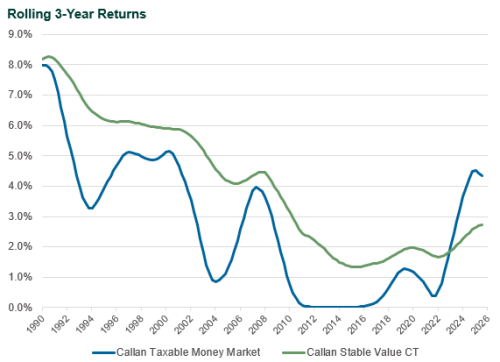
Performance disparities can also work in both directions. Following the Global Financial Crisis, when the Fed cut its target rate to zero, the median money market fund had an annualized return of 0.0% over the eight years from 2009 through 2016, while the median stable value fund had an annualized return of 1.7%. And net-of-fee money market returns would likely have been negative had most managers not reduced or waived fees during that time. Stable value’s longer duration has been a disadvantage during the most recent hiking cycle, just as it was an advantage during the low-rate environment that followed the GFC.
Where Are We Today?
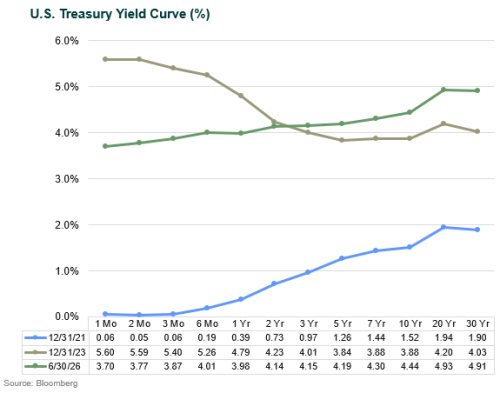
The market environment has improved significantly for stable value. Following the Fed’s 2022-23 rate hikes, the Treasury yield curve became deeply inverted, with short-term yields substantially higher than intermediate- and long-term rates, an environment that heavily favored money market funds. Beginning in September 2024, however, the Fed lowered its overnight rate by a total of 175 bps, and the Treasury curve has since returned to a more normalized, upward-sloping shape.
At the same time, higher rates have gradually worked their way into stable value portfolios, raising the Callan Stable Value Collective Trust Peer Group’s median yield of the underlying bonds from 1.5% at the beginning of 2022 to 4.6% as of June 30, 2026. Market-to-book ratios have also recovered substantially. After bottoming at 91.9%, the median ratio rose to 96.9% at the end of 2025 before declining to 96.1% over the first half of 2026 as intermediate-term rates moved higher. As the ratio approaches 100%, more of today’s higher bond yields can flow through to participants via higher crediting rates.
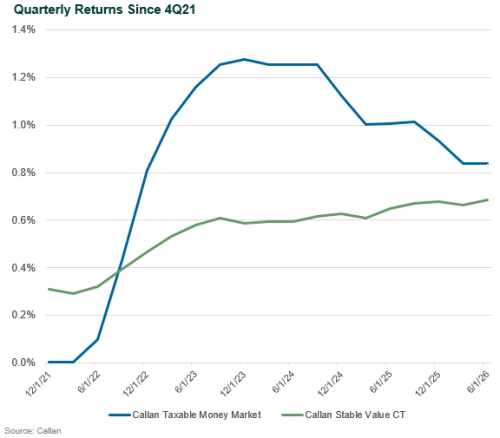
The results are reflected in relative performance. As of June 30, 2026, the margin by which money market funds have outperformed stable value funds has narrowed in each of the last 11 quarters to just 0.15% in the most recent quarter, though that streak may end in the third quarter following the Fed’s latest hike.
Moving forward, there are a number of ways stable value could finally pull ahead, but the most straightforward path is a decline in short-term rates. Money market funds have very little duration, a major advantage when rates rise but a disadvantage when they fall as their holdings mature and are reinvested at lower rates. However, the path of monetary policy is uncertain. Coming into 2026, the market was pricing in two to three Fed rate cuts. Instead, the Fed has already raised its overnight rate once, and expectations have shifted to at least one more this year.
Another path runs through intermediate-term yields, which have a more direct impact on stable value. Because stable value portfolios are longer in duration, performance is less closely tied to the overnight rate and more sensitive to factors such as inflation and economic growth. A decline in intermediate yields would immediately lift market values and the market-to-book ratio, a key input in the crediting rate calculation. A rise, by contrast, would initially put downward pressure on market values, as it has in recent years. However, today’s higher starting yields provide an advantage compared to 2022. With intermediate Treasuries yielding near 5%, the income generated by the portfolio provides a greater cushion to offset price declines from an increase in rates.
Even if rates stay where they are, time works in stable value’s favor. As underlying bonds approach maturity, the remaining market-to-book gap narrows, and as proceeds are reinvested at today’s higher yields, crediting rates should continue to rise.
Closing Thoughts
The rapid rise in short-term interest rates during 2022-23 gave money market funds an unprecedented advantage over stable value funds, and that advantage has persisted longer than many anticipated. But throughout one of the most challenging bond market environments in history, stable value has continued to perform as intended. Underlying portfolios have higher yields, market-to-book ratios have recovered much of their earlier declines, and crediting rates continue to climb.
The last several years have been a unique challenge, but it’s important for participants and plan sponsors to keep the recent period in context. The money market fund advantage reflects an unusual rate environment, not a flaw in stable value’s design. The same structural characteristics that caused stable value to respond slowly to rising rates may ultimately help it retain higher income for longer if they fall. Stable value has tested investors’ patience, but history has demonstrated its value as a core plan option over full market cycles.
Disclosures
The Callan Institute (the “Institute”) is, and will be, the sole owner and copyright holder of all material prepared or developed by the Institute. No party has the right to reproduce, revise, resell, disseminate externally, disseminate to any affiliate firms, or post on internal websites any part of any material prepared or developed by the Institute, without the Institute’s permission. Institute clients only have the right to utilize such material internally in their business.