
Listen to This Blog Post
Venture capital is a form of private investment typically in startup companies, where investors provide capital to support the growth of an emerging business generally in exchange for an equity stake. The goal of venture capital is typically to back promising young companies early in their lifecycle and in the hope that they may grow successfully.
How Venture Capital Typically Works
Venture-backed businesses are typically startups developing new products or services, often in the technology or health care sectors. These businesses raise money in distinct financing rounds (i.e., seed, series A, series B, etc.), with the capital typically used to hire employees, build products, and/or scale operations. Investors generally take minority ownership positions of roughly 5%-20% and often offer strategic guidance during a company’s formative years. Over time, the objective is for the company to grow in value and ultimately achieve a successful exit through a sale or IPO.
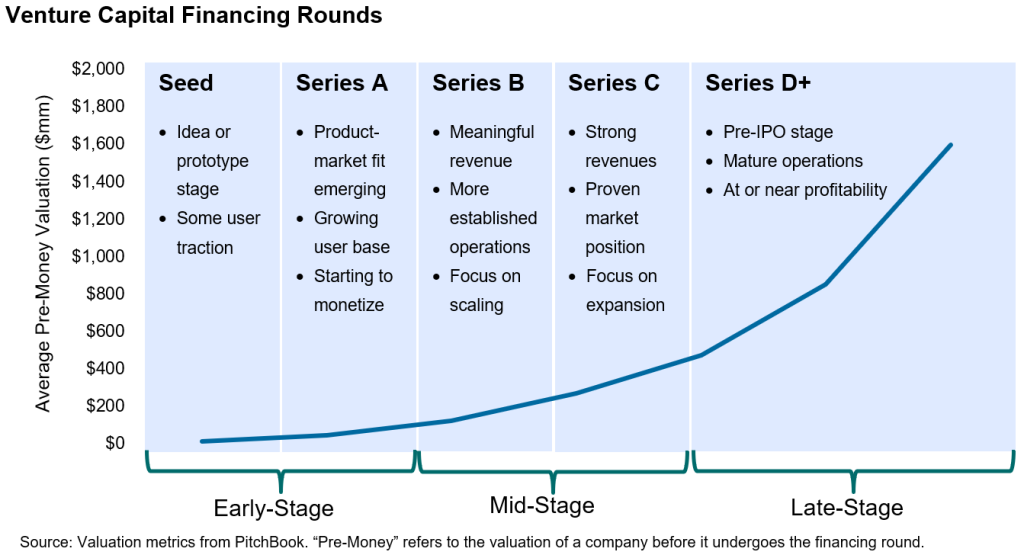
Venture capital is considered the highest risk/reward strategy type within private markets. Early-stage companies have limited operating histories, less financial stability, and take many years to mature. Backing companies at these early stages may provide the possibility of future gains, but it also carries a higher risk that many companies will fail or not grow as expected.
Because individual start-ups are high risk, venture capital is often accessed through commingled, closed-end funds. These funds pool money from many investors and spread it across multiple startups to reduce the risk of betting on a single company. A fund may invest across various stages, sectors, and/or geographies for added diversification. Similarly, it may be important to invest over multiple vintage years, as venture capital investments can be sensitive to technology’s innovation cycles as well as broader macroeconomic conditions. Ultimately within each venture capital fund, a small handful of “winners” typically drive the majority of returns, with a high number of expected losses.
This risk profile creates an exceptionally wide dispersion of returns among venture capital funds, as only the top managers have historically produced these outsized returns consistently (while many others produced more modest results). As a result, manager selection is especially critical in venture capital.
Furthermore, venture capital fund sizes tend to be smaller (corresponding to the smaller size of their investments) and access may be limited or closed to new investors, making it challenging to invest with the most sought-after firms. For some retail investors, a venture capital fund-of-funds can offer a more practical way to access these in-demand funds and potentially provide additional diversification.
In summary, venture capital offers the chance to participate in potentially high-growth opportunities that are not available through public stocks, but it comes with higher complexity, longer time horizons, higher risk, and less liquidity than other types of public and private investing. Success largely depends both on picking the right companies/managers and being in the right environment.
Disclosures
The Callan Institute (the “Institute”) is, and will be, the sole owner and copyright holder of all material prepared or developed by the Institute. No party has the right to reproduce, revise, resell, disseminate externally, disseminate to any affiliate firms, or post on internal websites any part of any material prepared or developed by the Institute, without the Institute’s permission. Institute clients only have the right to utilize such material internally in their business.