
Listen to This Blog Post
Private equity delivered a mixed start to 2026. While the overall asset class generated a modest 0.4% return in 1Q26, the headline result masks a growing divergence among strategies. Venture capital continued its AI-driven resurgence, while buyouts and growth equity struggled against a backdrop of weaker software valuations and macroeconomic uncertainty.
Details on 2Q26 Private Equity Activity
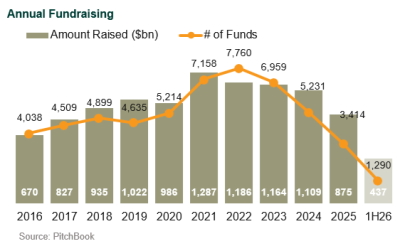
Fundraising | Private equity fundraising remained subdued through the first half of 2026, with capital raised tracking roughly in line with 2025 and well below the record pace established between 2021 and 2024. Investors continued concentrating commitments into the industry’s largest managers, reducing the overall number of funds raised year over year. Venture capital illustrated this trend particularly well: Four funds accounted for $29 billion of commitments during the first half of the year. In addition, three Asia-focused funds raised another $38 billion. Because fundraising historically follows improvements in dealmaking and exits, a significant near-term recovery appears unlikely until liquidity conditions strengthen.
Deal Activity | Overall deal activity remained on pace with 2025, but underlying trends differed sharply across strategies.
Buyout activity weakened during 2Q as sponsors responded to a correction in software valuations, persistent inflation, temporarily wider credit spreads, and continued interest rate uncertainty. U.S. buyout volume declined roughly 25% year over year, while megadeals became much less common. Capital increasingly shifted toward energy and AI infrastructure opportunities, and although transaction volume softened, valuation multiples remained elevated because the highest-quality assets continued to attract buyers.
Venture capital moved in the opposite direction. Venture-growth investment during the first half of 2026 already exceeded the total recorded during all of 2025, fueled by large financings for OpenAI, Anthropic, and xAI. Early-stage investing also accelerated and is on pace for a record year as AI-powered coding tools reduce startup costs and support new company formation.
Exits | Exit activity remained uneven. Buyout exits did not sustain the improvement seen during 2025, with transaction volume declining from the first half of last year despite larger average deal sizes. Venture capital liquidity, however, continued to improve. Record exit value in 2026 was led by SpaceX’s initial public offering, while Anthropic and OpenAI could further expand the IPO pipeline if they complete public offerings. Those potential transactions would represent one of the strongest periods for venture-backed exits in recent years.
LP Distributions | Cash flows to investors showed modest improvement but remained below historical norms. During 2025, distributions totaled 12% of beginning net asset value, compared with the long-term average of roughly 20%. Encouragingly, distributions exceeded capital contributions for the first time since 2021, suggesting liquidity conditions may be gradually improving even if they have not yet normalized.
Dry Powder | Private equity dry powder continued its gradual decline from the peak reached in 2023. Slower fundraising has begun to offset ongoing investment activity, reducing the industry’s stockpile of undeployed capital. While managers still have significant capital available, today’s environment favors disciplined underwriting and selective deployment rather than rapid investment pacing.
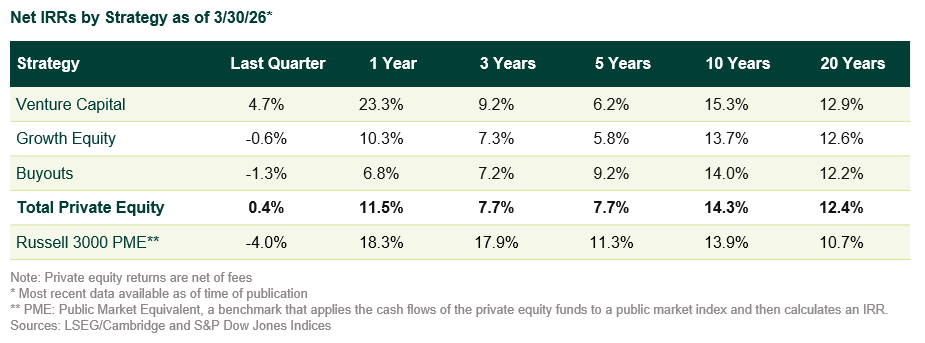
Performance | Venture capital remained the standout performer, advancing 4.7% in 1Q26 and 23.3% over the trailing year. Buyouts declined 1.3% for the quarter, while growth equity slipped 0.6%. Despite these short-term differences, longer-term results remain remarkably consistent. Over 10- and 20-year periods, venture capital, buyouts, growth equity, and the broader private equity universe all produced annualized returns in the 12%–15% range, outperforming the Russell 3000 public market equivalent (PME) Index.
For institutional investors, 1Q reinforced the recent divergence between venture capital and buyout investments. Venture capital continues to benefit from extraordinary AI-driven investment activity, while buyouts face a more measured operating environment. Maintaining diversified exposure to private equity strategies across market cycles remains an effective way to participate in the asset class’s long-term return potential.
Disclosures
The Callan Institute (the “Institute”) is, and will be, the sole owner and copyright holder of all material prepared or developed by the Institute. No party has the right to reproduce, revise, resell, disseminate externally, disseminate to any affiliate firms, or post on internal websites any part of any material prepared or developed by the Institute, without the Institute’s permission. Institute clients only have the right to utilize such material internally in their business.