
Listen to This Blog Post
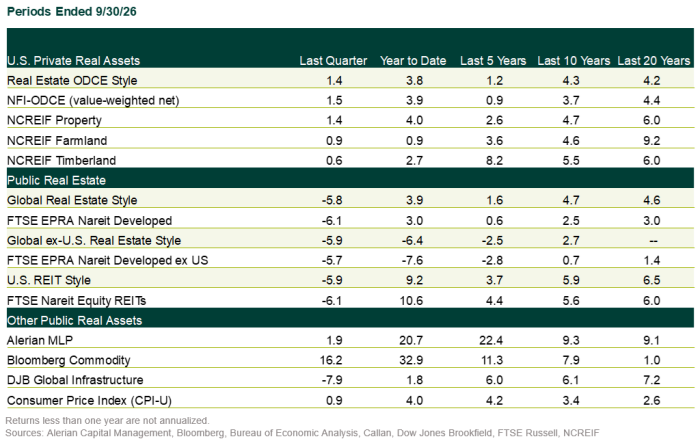
Real assets diverged in 3Q26 as private real estate continued to stabilize and rising bond yields pressured listed property and infrastructure. Commodities rallied, led by energy, while demand for power and data continued to support private infrastructure investment. Across private real estate, income remained the main source of returns, redemption queues declined, and transaction activity continued its recovery.
Private Real Estate Performance in 3Q26
The NCREIF Open-End Diversified Core Equity (ODCE) Index gained 1.7% before fees, comprising a 1.0% income return and 0.7% appreciation. The NCREIF Property Index advanced 1.4% before fees. Apartments and Office values lagged, while Retail saw the strongest gains. Senior Housing led by a wide margin.
The Midwest led regional performance. The West lagged, with flat appreciation reflecting softer industrial conditions in Southern California. Manager return dispersion within the ODCE Index remained elevated, driven by portfolio composition and sector exposure.
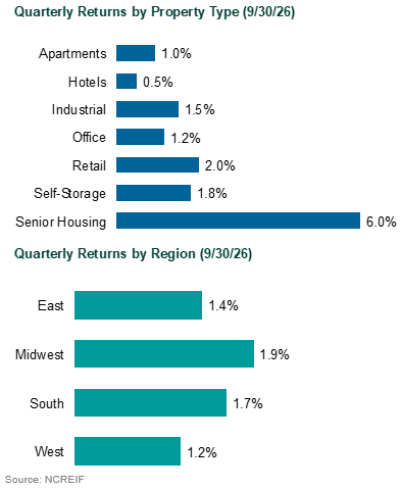
Core portfolios continued to shift toward Industrial and Multi-family properties as Office and Retail allocations declined. Alternative property types also gained ground as managers sought sectors with lower capital expenditure requirements and less sensitivity to economic growth. Investing across sectors with different demand drivers can help reduce reliance on any one segment of the real estate market. Geographic exposure remained concentrated in coastal regions.
Liquidity improved. ODCE redemption queues stood at approximately 8.7% of net asset value (NAV), with a median of 7.4%, according to 2Q26 data, the latest available. Queues have fallen sharply from their 19.3% peak in 1Q24. Larger redemption payments and rescinded requests drove the decline, with loyalty fee programs contributing in some cases. Nevertheless, outstanding requests among most large funds ranged from approximately zero to 38% of NAV.
Rolling four-quarter transaction volume increased and exceeded five-year averages, although activity remained below the recent peak in 1H22. During 3Q26, the number of transactions rose from the previous quarter while total transaction value declined. Valuations have largely adjusted to higher borrowing costs, supporting the recovery from the slowdown between 2022 and 2024. That said, higher interest rates could slow transaction activity again as borrowing costs increase and renewed pressure on property valuations emerge. So, while we’re seeing signs of recovery, the pace of improvement may be more gradual than previously anticipated.
Bank commercial real estate lending continued to recover. Lower loan-to-value requirements, however, forced borrowers to seek additional capital, creating opportunities for private credit providers. Lenders increasingly required refinancing or repayment at higher rates, contributing to defaults and the resolution of distressed assets, particularly in Office.
Public real assets faced different conditions. Global real estate investment trusts (REITs) lost 6.1%, trailing the MSCI World Index’s 1.9% gain. U.S. REITs also fell 6.1%, compared with declines of 9.2% in Europe and 3.3% in Asia. Global REITs traded at an 11.3% discount to NAV, wider than their 15-year average discount of 3.6%.
Commodities rallied as fading hopes for a U.S.-Iran deal and a widening conflict drove crude oil prices higher. Natural resource equities led listed real assets, supported by energy stocks. Higher yields weighed on listed infrastructure and TIPS.
Private infrastructure dealmaking remained strong. Infralogic reported approximately $1.4 trillion across roughly 2,900 transactions through October 28, 2026, following a record $1.7 trillion in 2025. Demand for data and power, including investment tied to artificial intelligence (AI), supported market growth.
Power generation and data centers led private infrastructure performance over the three years through 2Q26, with annualized gross returns of 38.8% and 23.5%, respectively, according to MSCI. Airports and transport advanced steadily, while renewables lagged as subsidies and incentives shifted.
Infrastructure continued to face competing forces. AI investment and power scarcity supported demand and pricing, while higher interest rates pressured valuations and refinancing. Rising construction costs, regulatory scrutiny of grid affordability, and the closing federal incentive window for wind and solar added challenges. Fundraising rebounded in 3Q26, led by power and energy, but remained concentrated in a few large funds. Continuation vehicles have also become a standard exit route, providing additional liquidity.
Disclosures
The Callan Institute (the “Institute”) is, and will be, the sole owner and copyright holder of all material prepared or developed by the Institute. No party has the right to reproduce, revise, resell, disseminate externally, disseminate to any affiliate firms, or post on internal websites any part of any material prepared or developed by the Institute, without the Institute’s permission. Institute clients only have the right to utilize such material internally in their business.