
Listen to This Blog Post
Signs of stabilization continued to emerge across real assets during 2Q26. Private real estate fundamentals improved modestly, transaction activity continued to recover, and infrastructure benefited from durable secular growth themes. At the same time, public real assets markets reflected a changing macroeconomic backdrop as easing geopolitical tensions, shifting interest rate expectations, and artificial intelligence (AI)-related investment continued to influence performance.
Private Real Estate Performance in 2Q26
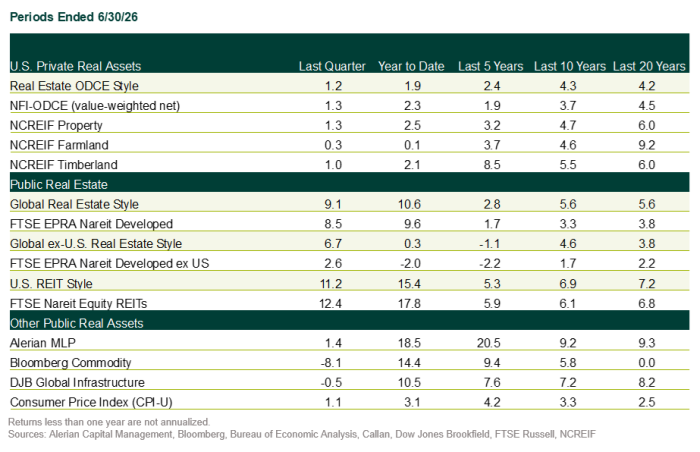
Private core real estate posted another positive quarter. The NCREIF Open-End Diversified Core Equity (ODCE) Index gained 1.3%. Performance varied across property sectors. Industrial, Retail, Self-Storage, and Senior Housing all generated positive appreciation, while Residential and Office remained slightly negative. Senior Housing stood out as the strongest-performing sector, reflecting continued favorable demographic trends and operating fundamentals. Regionally, the West lagged other parts of the country as softer industrial conditions in Southern California weighed on returns. Manager performance dispersion also remained elevated, highlighting the importance of portfolio composition and sector positioning.
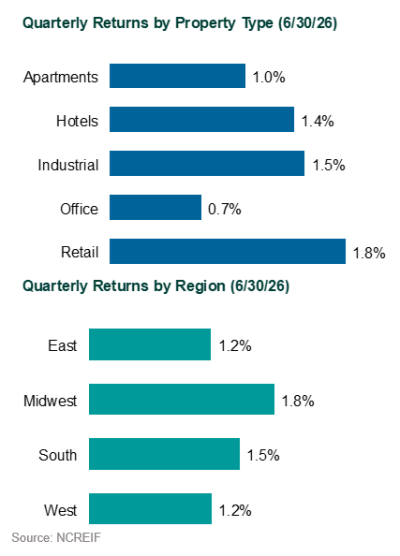
Core portfolios continue to evolve as institutional investors seek greater resilience. Industrial and Multi-family properties now account for a much larger share of ODCE portfolios than in prior decades, while Office and Retail exposures have steadily declined. Allocations to alternative property types have also grown as managers pursue sectors with lower capital expenditure requirements and less sensitivity to broad economic growth.
Liquidity conditions continued to improve. Redemption queues across ODCE funds fell to approximately 9.9% of net asset value, down significantly from the peak reached in early 2024 and below post-Global Financial Crisis highs. The improvement reflects a combination of larger redemption payments, rescinded withdrawal requests, and, in some cases, the introduction of loyalty fee programs that encourage investors to remain invested.
Property market activity also continued its recovery. Rolling four-quarter transaction volume increased both by the number of properties traded and by total transaction value. Although activity remains below the elevated levels recorded during the first half of 2022, pricing has largely adjusted to higher borrowing costs, allowing buyers and sellers to transact with greater confidence.
Capital markets are becoming more supportive, even as refinancing challenges remain. Banks have gradually increased commercial real estate lending activity, but lower loan-to-value requirements continue to create opportunities for private lenders. At the same time, lenders are increasingly requiring borrowers to refinance or repay loans rather than extending maturities, contributing to higher defaults and continued stress within portions of the Office market.
Public real assets performance was mixed. REITs produced the strongest returns among liquid real assets, supported by healthy leasing activity and improving property fundamentals. U.S. REITs gained 12.4% during the quarter, led by Hotels, Self-Storage, Office, and Health Care. Even after this strong performance, global REITs continue to trade at a modest discount to net asset value, creating opportunities for selective public-to-private acquisitions.
Commodity futures, however, declined as energy prices retreated following the easing of geopolitical tensions in the Middle East and the reopening of the Strait of Hormuz. Lower precious metals prices also weighed on returns as geopolitical risks moderated and expectations for tighter U.S. monetary policy strengthened. Natural-resource equities similarly declined as lower commodity prices pressured energy producers and precious metals miners.
Infrastructure continues to benefit from powerful long-term investment themes. U.S. infrastructure deal value reached approximately $596 billion in 2025, reflecting strong demand for assets tied to power generation, digital infrastructure, and AI-driven electricity consumption. Power generation and digital infrastructure also led private infrastructure performance, while airports and transportation assets continued to post solid results. Although renewable energy has lagged recently as policy incentives have evolved, long-term drivers—including digitization, electrification, aging infrastructure, and supply chain investment—remain supportive.
Disclosures
The Callan Institute (the “Institute”) is, and will be, the sole owner and copyright holder of all material prepared or developed by the Institute. No party has the right to reproduce, revise, resell, disseminate externally, disseminate to any affiliate firms, or post on internal websites any part of any material prepared or developed by the Institute, without the Institute’s permission. Institute clients only have the right to utilize such material internally in their business.