
You are currently viewing this website using the Internet Explorer (IE) web browser. This website has limited functionality in IE, and you won’t be able to download research documents. For an optimal experience, please access this website using any other supported web browser.
Listen to This Blog Post
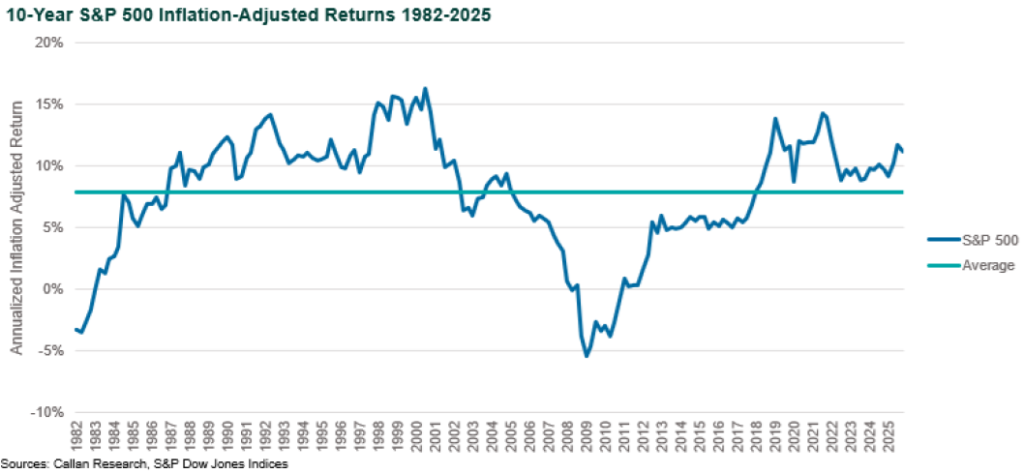
People often talk about how hard it is today. But looking at the stock market, things are pretty darn good for long-term investors such as our clients. The S&P 500’s 10-year annualized return was 11% at the end of 2025; that basically means investors have nearly tripled their money over the last decade, assuming they stayed in the market.
We wondered how common this type of return is. Investors are generally trained to think that the market should get you around 7%, which would approximately double your money every 10 years. But that’s before inflation, which is the rust to money’s metal–slowly degrading everything it touches.
So we took the S&P 500 and looked at real returns, those adjusted for inflation. We didn’t just want to do cumulative, because while 30-year time horizons have a certain intellectual appeal, most of our modeling and our Capital Markets Assumptions are built off of 10-year forecasts.
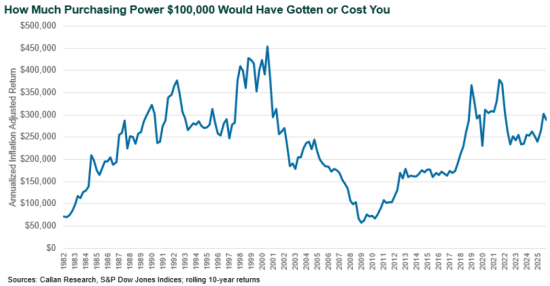
We took a rolling 10-year return and stripped out inflation. It turns out that the average return, starting in 1982 (so as if you had invested at the start of 1972) was 8%.
Looking over the entire time period from 1972 to 2025 (which means our first 10-year numbers start in 1982), and with the rolling 10-year return, we can see that there are only two periods, even with inflation, where you lost money: 1982-83 (data limitations preclude analysis prior to 1982), and June 2008 to December 2010. Of course, those are the early 1980s recession (Volker Recession) and the Global Financial Crisis.
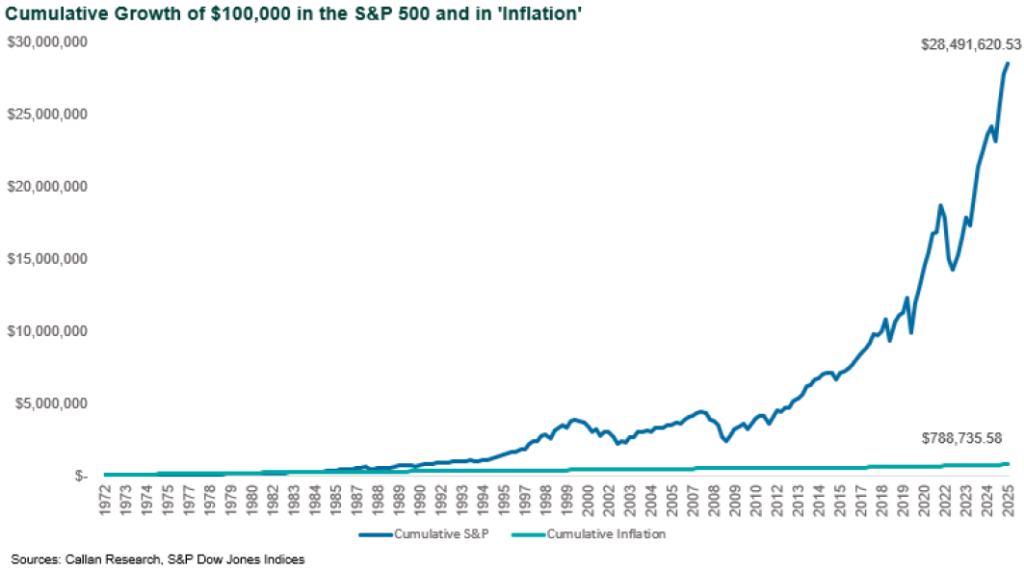
Now let’s assume you invested $100,000 in the S&P 500 in 1972. That would have grown to a total of $28.5 million (when millennials talk about how their parents bought their house for $50,000 in the 1970s, they probably didn’t realize they should have put it in the market!).
If you had somehow just invested in “inflation,” you would have had $788,000.
Just saying, it’s been an amazing 50 years of returns in the United States.
(Note, everything here ignores dividends, which averaged 2.8%, so just assuming that was the average dividend in the S&P 500, if you had invested $100,000 in 1972, it would have grown to the $28 million and also paid you another $6 million in cumulative dividends).
Disclosures
The Callan Institute (the “Institute”) is, and will be, the sole owner and copyright holder of all material prepared or developed by the Institute. No party has the right to reproduce, revise, resell, disseminate externally, disseminate to any affiliate firms, or post on internal websites any part of any material prepared or developed by the Institute, without the Institute’s permission. Institute clients only have the right to utilize such material internally in their business.


For Investment Managers & Advisers
You are now leaving Callan LLC’s website and going to Callan Family Office’s website. Callan Family Office is not affiliated with Callan LLC. Callan LLC has licensed the Callan® trademark to Callan Family Office for use in providing investment advisory services to ultra-high net worth clients, family foundations, and endowments. Callan Family Office and Callan LLC are independent, unaffiliated investment advisory firms separately registered with the Securities and Exchange Commission under the Investment Advisers Act of 1940.
Callan LLC is not responsible for the services and content on Callan Family Office’s website. Inclusion of this link does not constitute or imply an endorsement, sponsorship, or recommendation by Callan LLC of their website, or its contents, and Callan LLC is not responsible or liable for your use of it. When visiting their website, you are subject to Callan Family Office’s terms of use and privacy policies.