
Listen to This Blog Post
Since its launch in 2010, Callan Connects has grown from a modest outreach effort into a robust database of emerging and diverse-, women-, and disabled-owned (DWDO) investment managers. As of July 2026, Callan’s asset class specialists have now met with roughly 850 firms through the program—a milestone that reflects its staying power.
This blog post is an attempt to explain why the program was started, how it works, how it has changed, and how it helps both investment managers as well as our institutional investor clients.
Callan Connects was initially developed in partnership with a client seeking to identify new managers, specifically those that are either majority DWDO-owned (regardless of AUM or fund size) or emerging, defined as managing less than $3 billion in assets or raising fund I, II, or III under $1 billion. The program remains an important part of Callan’s comprehensive research process and supports institutional investors that are interested in diverse talent.
Callan Connects: A Program That Keeps Broadening
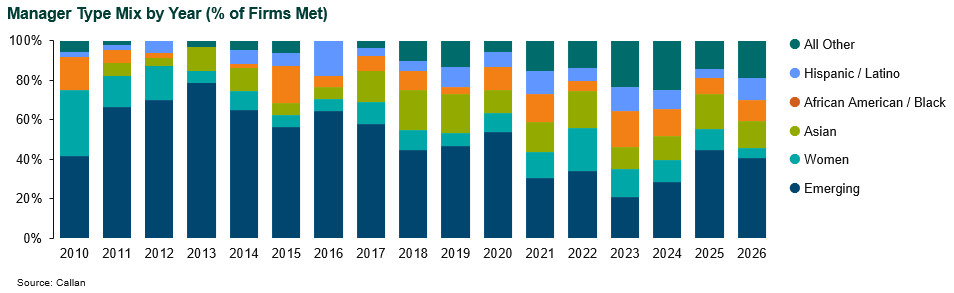
The number of meetings a year has steadily increased, from 36 the first year to an average of 86 a year over the last five years, with particularly strong growth since 2020. But the composition of those meetings has shifted just as much as the volume. Emerging managers made up more than 60% of firms met annually through Callan Connects during much of 2010–17; in 2025–26, that share has settled closer to 40%–45%. In their place, engagement with DWDO-owned managers has broadened across every ownership category Callan tracks, with each major group (women-, Asian-, African American/Black-, and Hispanic/Latino-owned firms) now accounting for roughly 10%–20% of annual meetings. Rather than concentrating on any single category, the program has diversified its own outreach in step with the market it covers.
Private Markets Take Center Stage
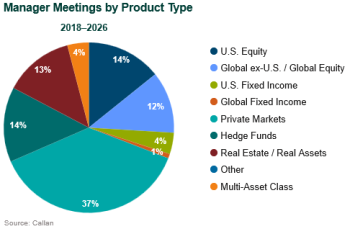
The product mix has moved just as dramatically as the manager mix. From 2010–17, U.S. equity dominated Callan Connects meetings, accounting for more than half of all engagements, with private markets strategies representing less than 10%. From 2018–26, that picture flipped: private markets (equity and debt) now make up 37% of meetings, while U.S. equity has fallen to just 14%. Global equity, hedge funds, and real estate/real assets strategies have each carved out a meaningful, more evenly distributed share of the program as well. That rebalancing tracks closely with institutional investors’ own growing appetite for private markets, and with a wave of new emerging and diverse managers entering the private markets space.
A New Track System
In January 2025, Callan split the program into two distinct tracks to better match the format of each meeting with where a manager sits in its lifecycle. Track 1 is designed for firms in their earliest stages—defined as those within one year of inception and/or managing less than $50 million—where specialists focus on high-level feedback and support. Track 2 is built for firms with more than $50 million in AUM that are actively looking to expand their client base with strategies already in demand; these conversations dig into team, strategy, process, and performance with an eye toward identifying manager talent Callan may bring to client searches.
While it is early, Track 2 now accounts for two-thirds of the meetings, a sign that more of the managers coming through the program are further along in their growth and ready for a deeper evaluation. This is an interesting trend, and we will continue to monitor it as it evolves.
What It All Adds Up To
Taken together, the data points to a program that has matured well beyond its original scope: broader in the types of ownership it engages, more balanced across asset classes—especially private markets—and increasingly focused on managers with the scale and track record to be seriously considered for client portfolios. As institutional investors continue to seek diverse and emerging manager talent, Callan Connects remains a key pipeline for identifying promising managers early and tracking their development over time.
Former Callan interns Arjun Aujla and Eden Vann contributed to this blog post.
Disclosures
The Callan Institute (the “Institute”) is, and will be, the sole owner and copyright holder of all material prepared or developed by the Institute. No party has the right to reproduce, revise, resell, disseminate externally, disseminate to any affiliate firms, or post on internal websites any part of any material prepared or developed by the Institute, without the Institute’s permission. Institute clients only have the right to utilize such material internally in their business.