
Listen to This Blog Post
Private credit entered 2026 from a position of relative strength. Although returns moderated from the previous quarter, the asset class again demonstrated its resilience by outperforming both leveraged loans and high yield bonds during a challenging first quarter for public credit markets. At the same time, investors continued to shift capital toward specialized lending strategies, financing conditions became increasingly competitive, and early signs of a recovery in merger and acquisition (M&A) activity emerged.
Key Trends in Private Credit
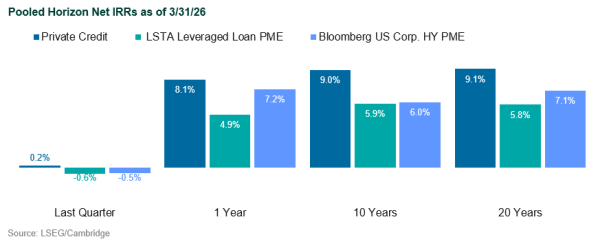
Returns | Private credit generated a pooled horizon net internal rate of return (IRR) of 0.2% in 1Q26, bringing its one-year return to 8.1% and its 10-year return to 9.0%. Despite the muted quarterly gain, the asset class outperformed both leveraged loans and high yield bonds, which posted negative returns during the quarter. Within private credit, subordinated debt and credit opportunities remained positive performers, while senior debt was the only major strategy to finish the quarter in negative territory. Over longer periods, higher-risk strategies continue to generate stronger returns, with subordinated debt producing a 10.9% 10-year IRR compared to 7.6% for senior debt.
Fundraising | Capital raising remained selective but continued to evolve. Direct lending regained the lead in fundraising during the quarter, supported by large fund closes from Sixth Street and BlackRock. At the same time, investors maintained interest in complementary strategies, with secondaries and asset-based finance (ABF) represented among the largest funds raised. European-focused vehicles also featured prominently, accounting for two of the four largest fund closes. Although fundraising activity remained below the elevated levels seen several years ago, capital continues to flow toward established managers and differentiated lending strategies.
Spreads | Competitive financing conditions continued to reshape the market. Direct lending spreads narrowed; nearly two-thirds of new direct lending leveraged buyout (LBO) deals over the past 12 months priced below 500 basis points over the benchmark rate, a sharp increase from recent years. As a result, the spread premium over the broadly syndicated loan market narrowed to approximately 149 bps, the tightest level of the current cycle.
Issuance | M&A-related loan issuance accelerated during the first quarter. Institutional issuance totaled $51.2 billion, including $29.0 billion supporting leveraged buyouts. If sustained, the current pace would annualize to approximately $205 billion—well above 2025’s total of $142.4 billion. Sponsor-backed transactions represented more than half of quarterly issuance, suggesting private equity activity is beginning to recover as financing markets stabilize. Even so, overall issuance remains below the record levels reached during 2021.
Headwinds | Broader market headlines continued to focus on private credit’s exposure to technology companies and AI-related investments. While software lending has historically benefited from recurring revenue models and attractive growth characteristics, rapid advances in artificial intelligence have prompted investors to reassess long-term valuations and business risks. At the same time, concerns surrounding AI infrastructure spending contributed to volatility in public business development companies (BDCs) and higher redemption requests at some semi-liquid private credit funds.
Despite these concerns, the anticipated surge in credit defaults has yet to emerge. Private credit default rates remain below those of the high yield market, supported by covenant protections, sponsor support, and lenders’ ability to work proactively with borrowers. As competition increases and spreads tighten, manager selection, underwriting discipline, and workout capabilities remain critical factors in distinguishing long-term performance.
Disclosures
The Callan Institute (the “Institute”) is, and will be, the sole owner and copyright holder of all material prepared or developed by the Institute. No party has the right to reproduce, revise, resell, disseminate externally, disseminate to any affiliate firms, or post on internal websites any part of any material prepared or developed by the Institute, without the Institute’s permission. Institute clients only have the right to utilize such material internally in their business.


