
Listen to This Blog Post
Private credit involves direct lending or other forms of non-bank financing to companies outside of the traditional public debt markets. Private credit has grown significantly since the Global Financial Crisis, as banks retreated from middle-market lending and institutional investors sought yield in a low-rate environment.
Why Invest in Private Credit?
Fund Structure: Private credit funds can be structured as closed-end limited partnerships (lifespan of 7–10 years) or as evergreen, open-ended structures. Investors, or limited partners (LPs), commit capital that the investment manager, or general partner (GP), deploys into a diversified set of loans and credit instruments.
Returns: Private credit offers attractive risk-adjusted returns, generally higher than traditional fixed income. Over a full credit cycle, private credit has delivered returns in the 7%–12% range, depending on strategy. The illiquidity premium compensates investors for locking up capital and bearing credit risk.
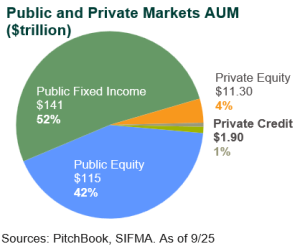
Diversification: The asset class provides portfolio diversification relative to public equities and bonds, with return drivers linked to private lending dynamics and contractual income streams.
Income Generation: Yields are typically higher than broadly syndicated loans or public bonds, with floating-rate structures that offer protection in rising rate environments.
Challenges of the Asset Class
Illiquidity: Unlike public bonds, private loans cannot be easily traded. The secondary market is smaller and more thinly traded. Evergreen or semi-liquid strategies provide more frequent subscription opportunities, typically monthly, and redemption opportunities, typically quarterly.
Fees: Management fees typically range from 0.75%–1.5% with carried interest of 0%–15% on profits.
Credit Risk: Borrowers are often middle-market companies with limited access to public capital markets, making credit underwriting and monitoring essential.
Manager Selection: There is a wide dispersion of returns across managers due to differences in sourcing networks, underwriting standards, and workout experience.
Program Complexity: Private credit requires oversight of loan servicing, covenants, and compliance.
Benchmarking: The asset class lacks a perfect benchmark, as no passive, investable index exists. Investors often use a peer group of comparable funds such as the Cambridge Private Credit Index or a public markets index with a spread, such as the Morningstar LSTA US Leveraged Loan Index.
Investment Timeline
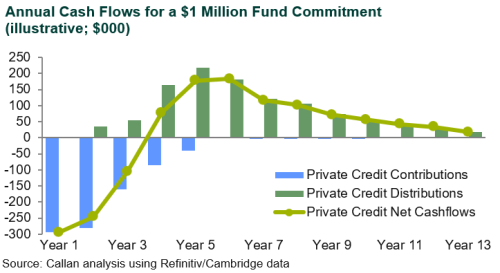
Investment Period: The GP draws capital to originate or purchase loans and credit investments across 20–50+ borrowers.
Income & Amortization: Cash flows begin during the first year, as interest and amortization payments are made throughout the loan term. Cash flows can be recycled to make new investments.
Exit / Repayment: Loans mature, are restructured, or sold within 2–5 years. Managers can recycle or distribute capital back to investors, depending on fund structure.
Strategy Types
Private credit spans a range of strategies:
- Direct Lending: Senior secured loans to sponsor-backed middle-market companies
- Asset-Based Lending/Specialty Finance: Lending against real assets or liquidating pools of non-corporate assets
- Mezzanine Debt: Subordinated loans with higher yields, often including equity warrants
- Distressed Debt: Investments in troubled companies, with opportunities for restructuring or control
- Opportunistic Credit: Flexible approach targeting dislocations across credit markets
- Secondaries: Purchases of existing private credit fund interests or portfolios
- Co-Investments: Direct loan participation alongside the general partner, either individually or through a pooled fund
Return Metrics
Because the GP has discretion over the timing of cash flows, private credit strategies emphasize IRR, current yield, and distributed capital.
- IRR: Internal Rate of Return. The implied discount rate that equates the present value of cash outflows (Paid-In Capital) with the present value of cash inflows (Distributions + NAV). Unlike total value to paid-in (TVPI) capital, defined below, this calculation incorporates the time value of money.
- DPI: Distributions to Paid-In Capital. The portion of TVPI that has been realized as cash is returned to investors.
- Current Yield: Annualized interest income as a percentage of invested capital, an important metric for income-focused investors.
- TVPI: Total Value to Paid-In Capital. A more simplistic ratio that measures the value of a private credit fund (both realized and unrealized) relative to the amount contributed (e.g., a 1.25x TVPI means $1 invested is worth $1.25). Because it does not account for the time value of money, the TVPI is best considered alongside the IRR.
Disclosures
The Callan Institute (the “Institute”) is, and will be, the sole owner and copyright holder of all material prepared or developed by the Institute. No party has the right to reproduce, revise, resell, disseminate externally, disseminate to any affiliate firms, or post on internal websites any part of any material prepared or developed by the Institute, without the Institute’s permission. Institute clients only have the right to utilize such material internally in their business.


