
Listen to This Blog Post
Hedge fund industry assets reached a record $5.64 trillion in 3Q26. Equity long/short managers faced pressure from reversals in crowded positions, while quantitative and relative value strategies provided offsets. For institutional investors, the quarter highlighted differences in how hedge fund strategies respond to changing equity, credit, and interest rate conditions.
Hedge Fund Growth and Flows
According to HFR, industry capital increased $480.4 billion, or 9.3%, from year-end 2025. Net inflows totaled $124.1 billion through September, including $34.5 billion during 3Q. The estimated number of funds, excluding funds of funds, rose to 8,631, an increase of 100 from year-end 2025.
Total assets edged up $7.1 billion during the quarter, following strong growth in the first half. Macro strategies recorded the largest quarterly asset increase, adding $40.0 billion to reach $897.5 billion. Relative value assets increased $19.2 billion to $1.45 trillion. Equity hedge assets declined $31.6 billion to $1.72 trillion, while event-driven assets fell $20.5 billion to $1.57 trillion.
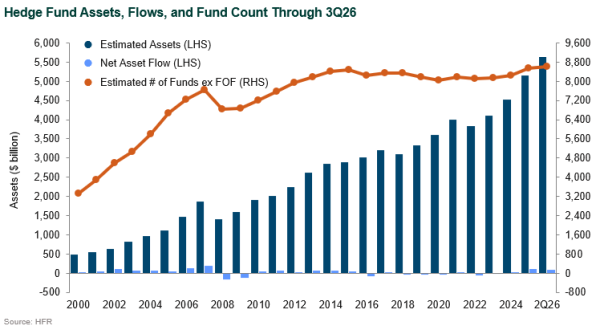
Assets remained concentrated among larger firms. Managers with more than $5 billion represented 10.0% of firms but held 78.6% of industry assets. Firms below $1 billion accounted for 72.2% of firms and just 5.8% of assets. Firms managing $1 billion to $5 billion represented 17.8% of firms and 15.6% of assets.
Fund formation exceeded closures during the first half of 2026. HFR estimated 266 launches and 199 liquidations, a net increase of 67 funds. Both launches and liquidations remained well below levels recorded before and during the Global Financial Crisis.
Strategy Performance
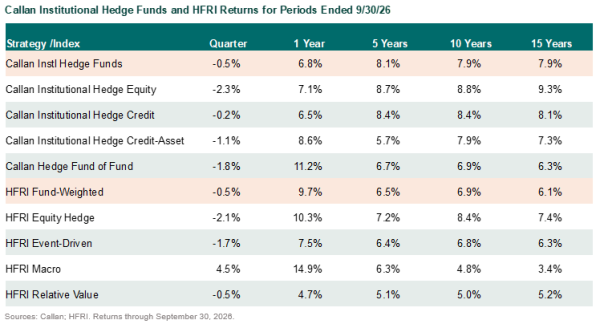
Equity long/short strategies absorbed the sharpest pressure. Crowded AI and semiconductor positions reversed in July, and narrow market breadth limited participation in the recovery. Both lower-net-exposure and long-biased portfolios lost money. Asia and industrials specialists detracted most, while generalists fared better through selected mega-cap holdings and profitable individual stock shorts.
Credit and event-driven results proved comparatively resilient but uneven. Stressed corporate credit, distressed investments, special situations, and non-qualified mortgages weakened as rates rose. Other asset-backed managers continued to earn positive carry. Results reflected differences in contractual income and corporate catalysts, as well as sensitivity to interest rates, credit spreads, and equities.
Global macro offered uneven diversification. Fixed income relative value, selected commodities, and thematic equities supported some managers. Positions anticipating lower European short-term rates and steeper yield curves detracted as tightening expectations shifted. Managers positioned for higher sovereign yields later in the quarter performed better.
Quantitative and relative value strategies provided the clearest offsets. Short-term equity strategies led quantitative gains, while medium-term equity and futures strategies also advanced. Relative value benefited from dispersion among individual stocks and favorable sector and factor positioning. Commodity and credit trades contributed, while convertible arbitrage posted modest losses.
Portfolio Considerations
The federal funds target range stood at 3.75%–4.00% as of Oct. 28, following a September increase of 25 basis points and an October decision to hold the range unchanged.
The interest rate environment continued to support cash-rich and short-selling strategies through interest and rebate income, although that benefit remained below the 2023 peak. Elevated funding costs and tighter bank balance sheets also created opportunities in stressed credit, private lending, and event-driven capital solutions.
In terms of considerations from a portfolio perspective, the increase in interest in hedge funds is partially due to committee concerns over fixed income as a hedging asset class in an inflationary environment, which has led a lot of endowment committees to re-evaluate hedge funds’ role in the portfolio, favoring absolute return and market neutral over long/short equities.
Callan emphasizes differentiated return sources, appropriate leverage, transparency, and alignment through ownership and fees when evaluating managers. Areas to avoid include high correlations with broader markets during stress, incentive fees on market-driven returns, and substantial illiquid exposures.
Disclosures
The Callan Institute (the “Institute”) is, and will be, the sole owner and copyright holder of all material prepared or developed by the Institute. No party has the right to reproduce, revise, resell, disseminate externally, disseminate to any affiliate firms, or post on internal websites any part of any material prepared or developed by the Institute, without the Institute’s permission. Institute clients only have the right to utilize such material internally in their business.