
Listen to This Blog Post
Residential real estate has long played an important role in institutional portfolios because demand for housing tends to persist through changing economic environments. Within that universe, affordable housing has emerged as a growing area of interest—not simply because it addresses a pressing social need, but because it offers investment characteristics that differ from traditional market-rate apartments.
The investment case begins with a basic imbalance between supply and demand. The United States faces a shortage of roughly 3.7 million housing units, and the gap is especially acute for lower-cost rental housing. Rising construction costs, labor shortages, financing challenges, and land constraints have made new development increasingly expensive. Developers have responded by concentrating on higher-end properties, leaving relatively few new affordable units entering the market.
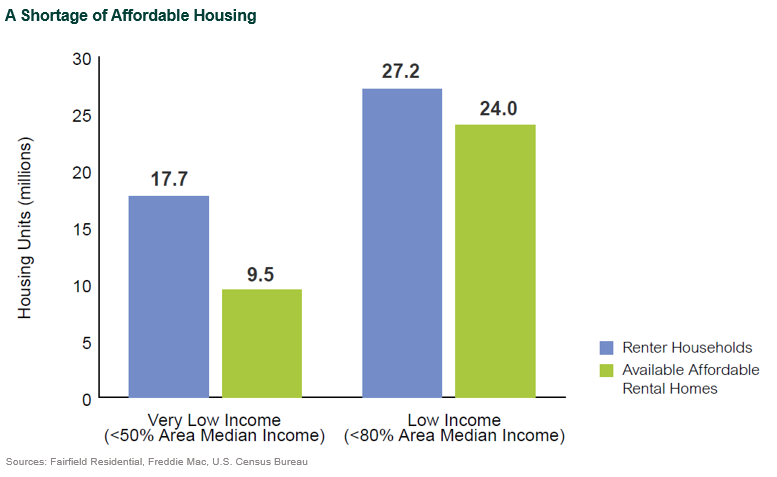
At the same time, affordability pressures continue to mount. Nearly half of U.S. households now spend at least 30% of their gross income on housing, a measure of what the U.S. Department of Housing and Urban Development defines as “cost-burdened.” Existing affordable housing also faces pressure as affordability restrictions on hundreds of thousands of units are scheduled to expire over the remainder of the decade, creating both preservation challenges and investment opportunities.
For investors, these structural trends translate into durable demand. Unlike many real estate sectors, where occupancy and rental growth often fluctuate with the economy, affordable housing demand is driven primarily by necessity. People require housing regardless of market conditions, and many renters have few alternatives.
Those dynamics have historically supported higher occupancy rates, lower tenant turnover, and more stable rental income when compared to market-rate apartments. Rent growth may be more modest because many properties operate under affordability guidelines and are generally tied to Area Median Income growth, but that same structure has historically helped reduce volatility during periods when conventional apartment markets weaken.
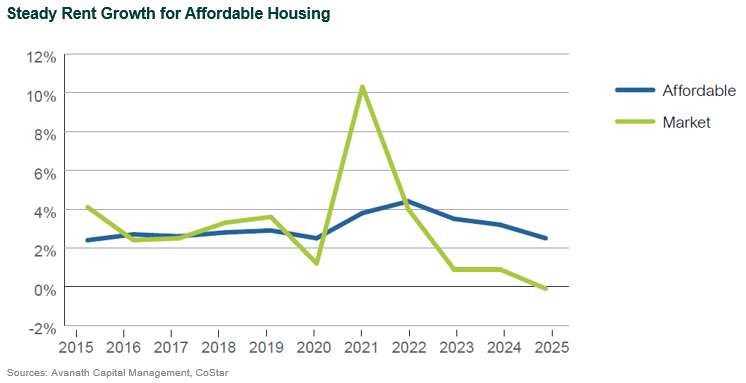
Another common misconception is that affordable housing requires investors to sacrifice returns in exchange for social impact. In practice, the sector has developed into a distinct institutional real estate strategy with its own economic drivers.
While rents are generally lower than comparable market-rate apartments, affordable housing often benefits from government-supported financing, property tax incentives, rental assistance programs, and other mechanisms that strengthen property economics. Combined with resilient occupancy and stable cash flows, these features have historically supported competitive risk-adjusted returns.
Affordable housing encompasses several different investment categories, each with distinct sources of revenue, regulation, and risk:
- Low-Income Housing Tax Credit: the primary federal program for financing affordable housing development, where investors provide equity capital in exchange for federal tax credits while properties remain subject to long-term affordability restrictions
- Section 8: properties that participate in federal rental assistance programs administered by the U.S. Department of Housing and Urban Development (HUD), under which tenants typically contribute approximately 30% of their household income toward rent and the federal government pays the remaining balance directly to the property owner
- Voluntary regulatory programs: State and local affordable housing programs that provide incentives, such as property tax abatements, in exchange for owners voluntarily agreeing to maintain affordability restrictions
- Naturally occurring affordable housing: residential units that are affordable to residents due to their age, location, physical characteristics, or market positioning rather than through formal affordability restrictions or government subsidy programs
Each strategy carries different operating characteristics, but all seek to capitalize on persistent demand for affordable housing.
The sector is not without challenges. Affordable housing requires more specialized operations than conventional apartments, including compliance with income certifications, rent restrictions, and regulatory reporting. Public policy also plays an important role because many programs rely on federal, state, or local incentives that can evolve over time. For these reasons, manager selection is particularly important. Experience navigating regulatory requirements and preserving affordability can be as critical to investment success as property selection itself.
As institutional interest has grown, so has the range of implementation options. Investors can now choose from closed-end and open-end funds, separate accounts, or, for organizations with sufficient resources, direct ownership. In recent years, open-end affordable housing funds have become an increasingly accessible option for investors seeking stable income and long-term exposure to the sector.
Affordable housing has evolved well beyond a niche strategy. Supported by enduring supply-demand imbalances, resilient operating fundamentals, and expanding institutional participation, it offers investors a differentiated way to broaden residential real estate exposure. For investors seeking exposure to durable residential demand, differentiated operating characteristics, and one of the most persistent supply-demand imbalances in the U.S. economy, affordable housing represents an increasingly institutionalized segment of the real estate market worthy of consideration.
Disclosures
The Callan Institute (the “Institute”) is, and will be, the sole owner and copyright holder of all material prepared or developed by the Institute. No party has the right to reproduce, revise, resell, disseminate externally, disseminate to any affiliate firms, or post on internal websites any part of any material prepared or developed by the Institute, without the Institute’s permission. Institute clients only have the right to utilize such material internally in their business.