
Listen to This Blog Post
Defining Core vs Core Plus Real Estate
Core real estate typically serves as the foundation of an institutional property portfolio. It emphasizes high-quality, well-leased assets—often 90%+ occupied—with durable cash flows and limited operating volatility. Core portfolios generally employ conservative leverage, commonly in the 20%–35% range, and they are underwritten to generate returns primarily through stable income rather than reliance on capital appreciation. Core strategies are most often concentrated in large, economically diverse metropolitan areas with deep labor pools and strong long-term demand drivers, including population growth, employment expansion, and concentrations of higher-value industries. Within those markets, core investors tend to favor established submarkets and properties with competitive locations, modern building standards, and institutional-quality specifications—characteristics that support resilient performance across market cycles.
Core plus real estate shares many of the same characteristics as core but incorporates a limited degree of additional risk in pursuit of higher total returns. Key distinctions typically include:
- Primarily stabilized, income-producing assets combined with select non-core exposures, such as value-add initiatives and/or development-to-core strategies.
- Modestly lower occupancy and/or shorter weighted-average lease terms in certain assets, reflecting partial lease-up or transitional business plans. Portfolios may also include older properties requiring light repositioning or capital investment—introducing incremental risk beyond core, but short of traditional value-add or opportunistic strategies.
- Greater exposure to alternative property types beyond the traditional Office, Industrial, Retail, and Apartment sectors.
- Selective exposure to secondary markets, which may feature smaller populations, fewer jobs, and lower liquidity relative to major gateway metros.
It is also important to note that core real estate funds are typically subject to the inclusion criteria of the NCREIF Fund Index – Open End Diversified Core Equity (NFI-ODCE), commonly referred to as ODCE, which is quite detailed but which includes open-end commingled funds primarily invested in private equity real estate in the United States with limited leverage (under 35%) and 75% of investments in traditional sectors. By contrast, the absence of these constraints gives core plus strategies greater flexibility in portfolio construction and management. ODCE requirements around sector mix, asset eligibility, leverage, and stabilization can limit adaptability, as ODCE funds often prioritize index alignment and liquidity mechanics over forward-looking value creation.
In addition, ODCE funds tend to be larger and therefore less nimble when adjusting exposures as market conditions evolve. Core plus strategies are generally better positioned to rotate capital as pricing, fundamentals, and liquidity shift across sectors and geographies, while traditional core funds may remain bound by static allocation targets.
The Impact of Greater Exposure to Alternative Property Types
Alternative property types—defined as real estate sectors outside of the traditional property sectors of Apartments, Industrial, Office, and Retail—have seen significant growth as a percentage of the private real estate universe. Using the ODCE Index as a proxy, alternative sector exposure has increased from 3.2% at year-end 2015 to 4.7% at year-end 2020 to 9.8% at year-end 2025. Callan finds that alternative sector exposure in core plus real estate funds is far higher than core real estate, estimated at 35% for core plus.
Alternative property sectors offer investors exposure to different tenant demographics across commercial and residential uses when compared to traditional property sectors, improving portfolio diversification. In addition, alternative property sectors generally benefit from strong demographic drivers, such as aging populations (which supports demand for health care property types such as medical office and senior housing), aging millennials (which supports demand for single-family rentals and build-to-rent), a consolidation among educational institutions (which supports demand for student housing at top-tier universities), and the growth of artificial intelligence and machine learning (which supports demand for data centers), among many others.
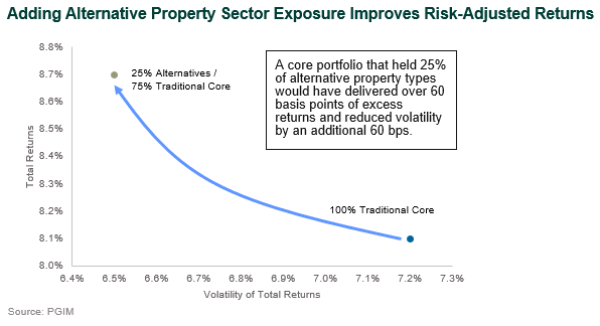
Research from PGIM has found that adding exposure to alternative property types to a core real estate portfolio improves risk-adjusted returns. The chart below provides a simplified example of a modeled portfolio of 25% alternatives and 75% traditional property types versus a 100% traditional portfolio. A blended portfolio has historically provided 60 additional basis points of returns and reduced volatility by an additional 60 basis points.
Analysis of NCREIF NFI-ODCE vs. Callan Core Plus Real Estate Index
Callan has leveraged its proprietary database to create a synthetic core plus real estate index. This index is comprised of 28 funds, which represent all open-end, diversified, core plus real estate funds that Callan tracks. Callan collected the quarterly return stream from each fund since inception and created an equal-weighted—as opposed to value-weighted—time-weighted return stream for the Callan Core Plus Real Estate Index.
Callan developed this index as a way to compare the performance of core plus real estate vs. core real estate and benchmark the performance of individual core plus funds.
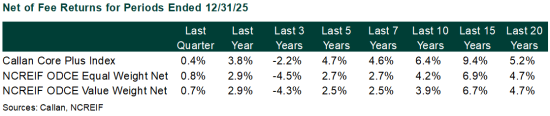


In this analysis, we found that the Callan Core Plus Real Estate Index has delivered persistent long-term outperformance versus the NCREIF NFI-ODCE Index equal-weighted across all trailing time periods. On a calendar year basis, the Callan Core Plus Real Estate Index delivered ~90 bps average annual excess return with an 80% hit rate (outperformed 16 out of 20 years, including 10 out of the last 10). The Callan Core Plus Real Estate Index underperformed during the Global Financial Crisis and outperformed in the subsequent recovery. Outperformance has been driven primarily by appreciation rather than income, reflecting the payoff from renovation, lease-up, development-to-core strategies, and more flexible sector rotation. Importantly, the Callan Core Plus Real Estate Index has experienced only slightly greater volatility, as expressed by standard deviation, and has a modestly higher Sharpe ratio over longer time horizons, indicating stronger risk-adjusted returns.
Disclosures
The Callan Institute (the “Institute”) is, and will be, the sole owner and copyright holder of all material prepared or developed by the Institute. No party has the right to reproduce, revise, resell, disseminate externally, disseminate to any affiliate firms, or post on internal websites any part of any material prepared or developed by the Institute, without the Institute’s permission. Institute clients only have the right to utilize such material internally in their business.