

You are currently viewing this website using the Internet Explorer (IE) web browser. This website has limited functionality in IE, and you won’t be able to download research documents. For an optimal experience, please access this website using any other supported web browser.
Underlying fund performance, asset allocation, and cash flows of more than 130 large defined contribution plans representing approximately $500 billion in assets are tracked in the Callan DC Index.
Index Rebounds Following 1Q26 Decline
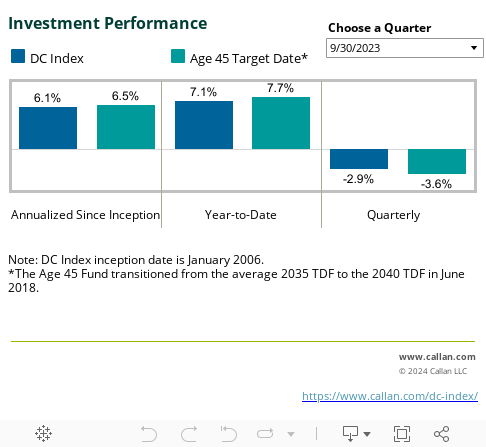
The Callan DC Index™ gained 11.2% during 2Q26, reversing the 1.9% decline in the prior quarter and bringing the trailing one-year return to 18.4%. Equity markets rebounded sharply after a volatile first quarter, with the S&P 500 up 15.2% and emerging markets up 24.1%, while the Bloomberg US Aggregate Bond Index gained 0.7%.
The Callan Target Date 2045 Peer Group outperformed the Index during both the quarter (12.3%) and the trailing one-year period (21.3%). Since inception,* the Peer Group has returned 8.6% annualized compared to 7.7% for the Index, primarily due to its higher equity allocation; the Index represents participants at all stages of their careers, including those at or near retirement. The Peer Group has outperformed in 53 of 63 rolling five-year periods, though it has typically trailed the Index in down quarters.
*The tracking of the Callan DC Index started in January 2006.
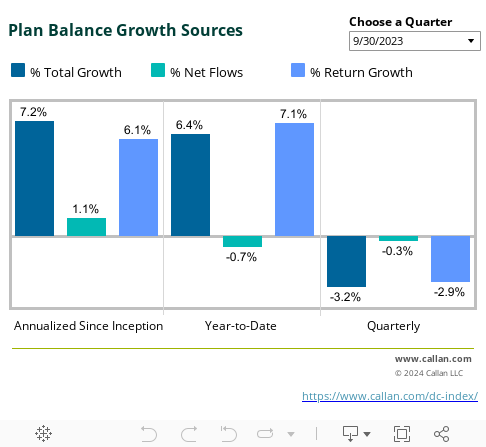
Investment Gains Outpace Net Outflows
Participant balances increased 10.1% during the quarter, reversing a 1.2% decline in 1Q26. Investment returns added 11.2%, the Index’s fourth-strongest quarterly return since inception, partially offset by net outflows of 1.1%. Net flows have been negative in every quarter of the last three years except 1Q26, and the three largest quarterly outflows in the Index’s history have occurred within the past year. After positive net flows in every year from 2007 through 2017, the Index has experienced net outflows each year since 2018, with annual outflows increasing each year since 2022 and reaching -4.8% in 2025.
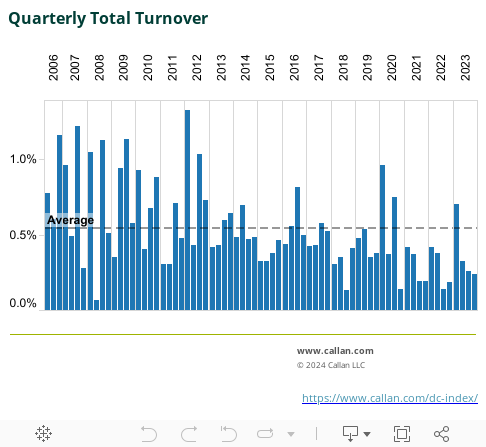
Net Transfer Activity Remains Negligible
Turnover (i.e., net transfer activity within DC plans) was just 0.01% in 4Q25, its lowest level since Index inception and well below the historical average of 0.51%.
This muted activity indicates minimal participant-driven reallocation across asset classes during the quarter, reinforcing that changes in asset allocation were largely driven by market performance rather than investor behavior.
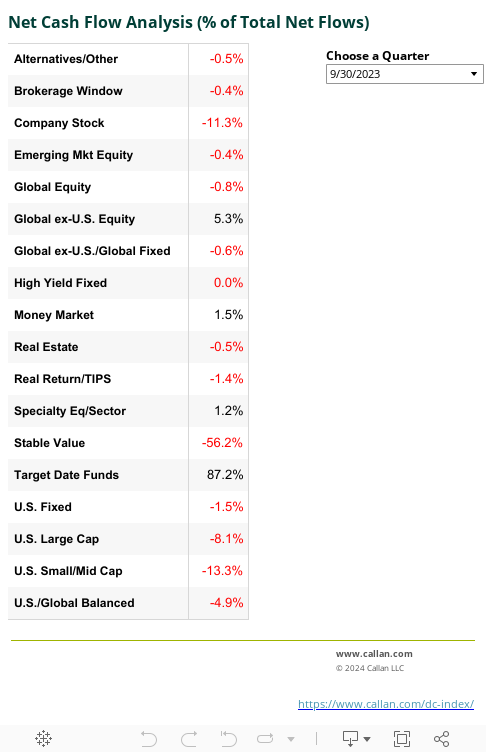
U.S. fixed income received 78.9% of total inflows during the quarter, followed by money market funds (6.7%) and real estate (5.4%). Outflows were heaviest in some of the quarter’s strongest-performing asset classes, with U.S. large cap equity (15.3%) and U.S. small/mid cap equity (17.7%) accounting for 70% of outflows, followed by stable value (-10.1% of outflows) and company stock (-4.9%). Outflows from U.S. large cap equity were broad-based, with nearly four in five plans offering the asset class recording net outflows. U.S. small/mid cap outflows were less representative of the broader Index, as a small number of plans accounted for approximately 40% of the total. Target date funds recorded modest net outflows (-3.4%). Target date funds have had net inflows in 78 of the Index’s 82 quarters, but all four quarters of outflows have occurred within the past two years. Net transfer activity was 0.05% during the quarter, below the Index’s historical average of 0.50%.
Equity Exposure Reaches a New High
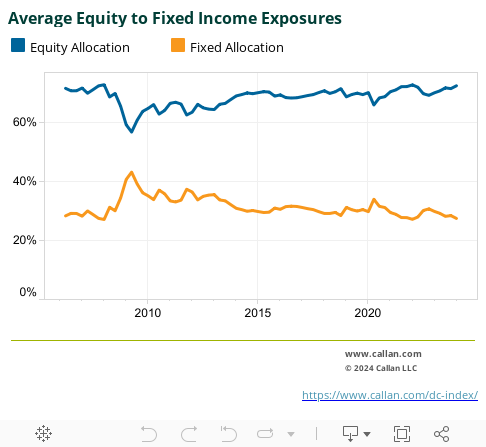
The Index’s overall equity allocation increased from 74.8% to 75.9% during the quarter, the highest level since the Index’s inception and well above its historical average of 69.2%.
Target Date Funds Remain the Largest Allocation
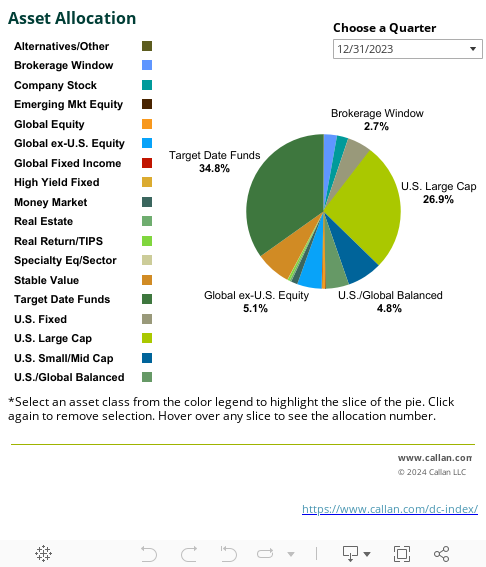
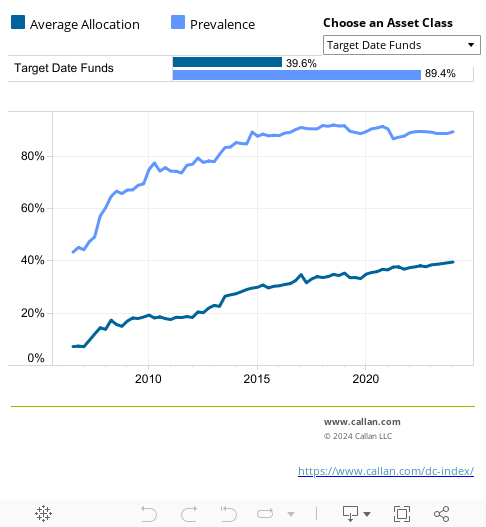
Target date funds represent 38.0% of Index assets, a record high, up from 37.6% at the end of the prior quarter. U.S. large cap equity remains the largest standalone allocation at 28.5% of assets, up from 27.8%, while stable value (4.5%) and U.S. fixed income (4.7%) declined as a share of assets. Passively managed strategies represent 44.2% of Index assets, the highest level since the Index’s inception, up from 42.2% at the end of 2Q25. Passive strategies account for 61.7% of U.S. large cap equity assets and 49.3% of target date fund assets.
Target Date Funds and Stable Value Remain Core Menu Offerings
Target date funds remain the most widely offered multi-asset solution, available in 89% of plans within the Index. Stable value is offered in 69% of plans, down from 71%. U.S. large cap equity, non-U.S. equity, and U.S. fixed income are each offered in all but one plan.
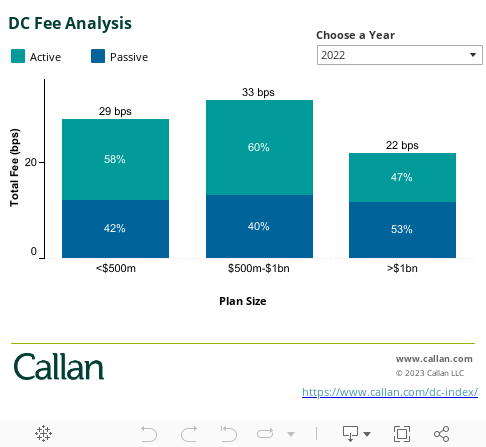
The DC Fee Analysis chart shows the average total investment management fee by plan size, as well as the average share of plan assets allocated to active and passive options. Fees for each fund (including mutual funds, collective trusts, and separate accounts) within a plan are asset-weighted to determine the average total fee. This exhibit will be updated annually with the release of third quarter DC Index results, and this updated data should be available shortly.
Using 3Q23 data, for plans with assets less than $500 million in assets, the average asset-weighted fee decreased by 3 basis points from 3Q22. Plans with assets between $500 million and $1 billion saw the largest fee decrease of 9 bps, while the fee for plans with more than $1 billion in assets had a decrease of 4 bps. Fee decreases were largely driven by a combination of increased use of passive mandates as well as lower breakpoints and new lower fee vehicles and share classes for actively managed options.
For Investment Managers & Advisers
You are now leaving Callan LLC’s website and going to Callan Family Office’s website. Callan Family Office is not affiliated with Callan LLC. Callan LLC has licensed the Callan® trademark to Callan Family Office for use in providing investment advisory services to ultra-high net worth clients, family foundations, and endowments. Callan Family Office and Callan LLC are independent, unaffiliated investment advisory firms separately registered with the Securities and Exchange Commission under the Investment Advisers Act of 1940.
Callan LLC is not responsible for the services and content on Callan Family Office’s website. Inclusion of this link does not constitute or imply an endorsement, sponsorship, or recommendation by Callan LLC of their website, or its contents, and Callan LLC is not responsible or liable for your use of it. When visiting their website, you are subject to Callan Family Office’s terms of use and privacy policies.