
You are currently viewing this website using the Internet Explorer (IE) web browser. This website has limited functionality in IE, and you won’t be able to download research documents. For an optimal experience, please access this website using any other supported web browser.
Listen to This Blog Post
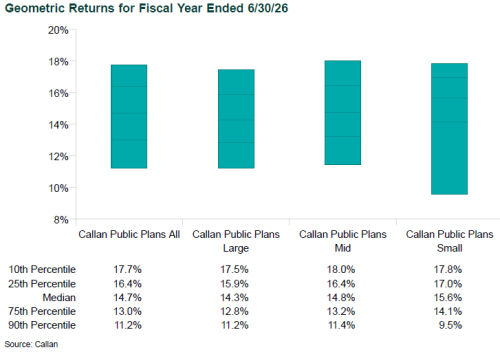
June 30 is the most common fiscal year-end for public defined benefit (DB) plans. In the fiscal year ended June 30, 2026, the median public plan gained 14.7%, more than double the median assumed rate of return of 7.0%.
This marks the fourth fiscal year in a row where the median public DB plan saw a return well in excess of the assumed rate of return (2025: 11.0%, 2024: 10.6%, 2023: 8.9%). Over the last four fiscal years, even public plans that ranked in the 95th percentile of the peer group earned returns in excess of the median assumed rate of return (8.0% vs. 7.0%). However, public plans are still making up ground from the brutal 2022 fiscal year, when the median plan lost 9.5%. Over the last five years (ended 6/30/26), the median public pension has an annualized return of 6.9%.
Over the last 12 months, all major asset classes (except non-U.S. fixed income) experienced gains. U.S. small cap (Russell 2000) and emerging markets (MSCI Emerging Markets) generated eye-popping returns north of 40%. U.S. large cap (S&P 500) and non-U.S. developed markets (MSCI World ex-USA) also generated strong returns, earning 22.3% and 21.0%, respectively. Alternative investments also produced double-digit gains with commodities up 25.5% (Bloomberg Commodities), hedge funds up 16.3% (HFRI Fund-Weighted), and private equity up 10.8% through 1Q26 (Cambridge Private Equity). Fixed income returns were more muted, with the Bloomberg Aggregate Index up 3.8% and high yield (Bloomberg High Yield Corp) rising 5.9%.
Against this backdrop, results by plan size were stellar during the June fiscal year. Small public plans (less than $100mm) generated the highest median return at 15.6%, outperforming their mid-size ($100mm to $1B), and large (greater than $1B) peers. The median small public plan allocates 60% of its portfolio to public equity versus 54% and 44% for mid-size and large public plan peers. Conversely, the median large public fund allocates 29% of its portfolio to alternatives versus just 8% for small public funds. Given this landscape, you can expect small funds to outperform their large peers when public markets are roaring, as the illiquid alternatives portfolios will take longer to react given the asset value smoothing in private markets.
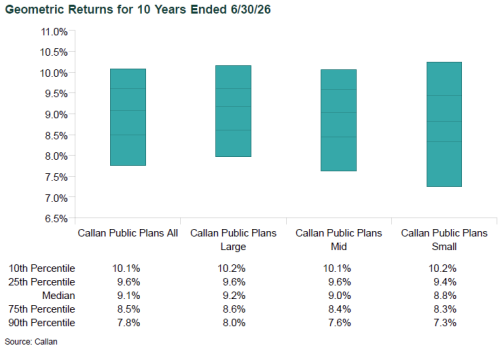
Over the 10-year timeframe, results are reversed, with the median large plan outperforming its smaller peers. Smaller public plans tend to have higher allocations to fixed income than their large peers (31% vs. 26%), and larger plans tend to use more esoteric credit. Over the last 10 years, core fixed income (Bloomberg Aggregate Index) has gained just 1.5% annualized, whereas high yield (Bloomberg High Yield Corp) and private credit (Cambridge Private Credit through 1Q26) have returned 5.8% and 7.5%, respectively.
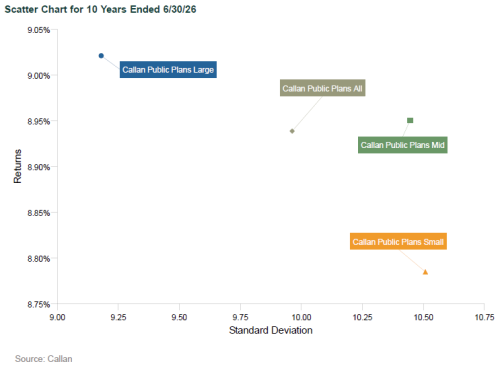
Looking through a different lens, volatility, large public plans have also fared better than their smaller peers over the last 10 years due to their more diversified portfolios. The asset smoothing of private markets investment values reduced the volatility of returns for larger plans as the realized volatility of those investments is reduced given the assets are priced less frequently (generally quarterly).
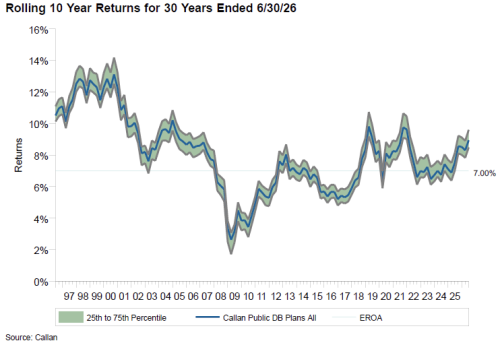
As always, Callan recommends public plans should focus on their ability to achieve their long-term EROA target rather than fixating on short-term volatility. The long-term approach has worked out over time as the median public plan’s 10-year return has consistently exceeded the median return hurdle of 7.0% (64% of rolling 10-year periods).
Disclosures
The Callan Institute (the “Institute”) is, and will be, the sole owner and copyright holder of all material prepared or developed by the Institute. No party has the right to reproduce, revise, resell, disseminate externally, disseminate to any affiliate firms, or post on internal websites any part of any material prepared or developed by the Institute, without the Institute’s permission. Institute clients only have the right to utilize such material internally in their business.


For Investment Managers & Advisers
You are now leaving Callan LLC’s website and going to Callan Family Office’s website. Callan Family Office is not affiliated with Callan LLC. Callan LLC has licensed the Callan® trademark to Callan Family Office for use in providing investment advisory services to ultra-high net worth clients, family foundations, and endowments. Callan Family Office and Callan LLC are independent, unaffiliated investment advisory firms separately registered with the Securities and Exchange Commission under the Investment Advisers Act of 1940.
Callan LLC is not responsible for the services and content on Callan Family Office’s website. Inclusion of this link does not constitute or imply an endorsement, sponsorship, or recommendation by Callan LLC of their website, or its contents, and Callan LLC is not responsible or liable for your use of it. When visiting their website, you are subject to Callan Family Office’s terms of use and privacy policies.